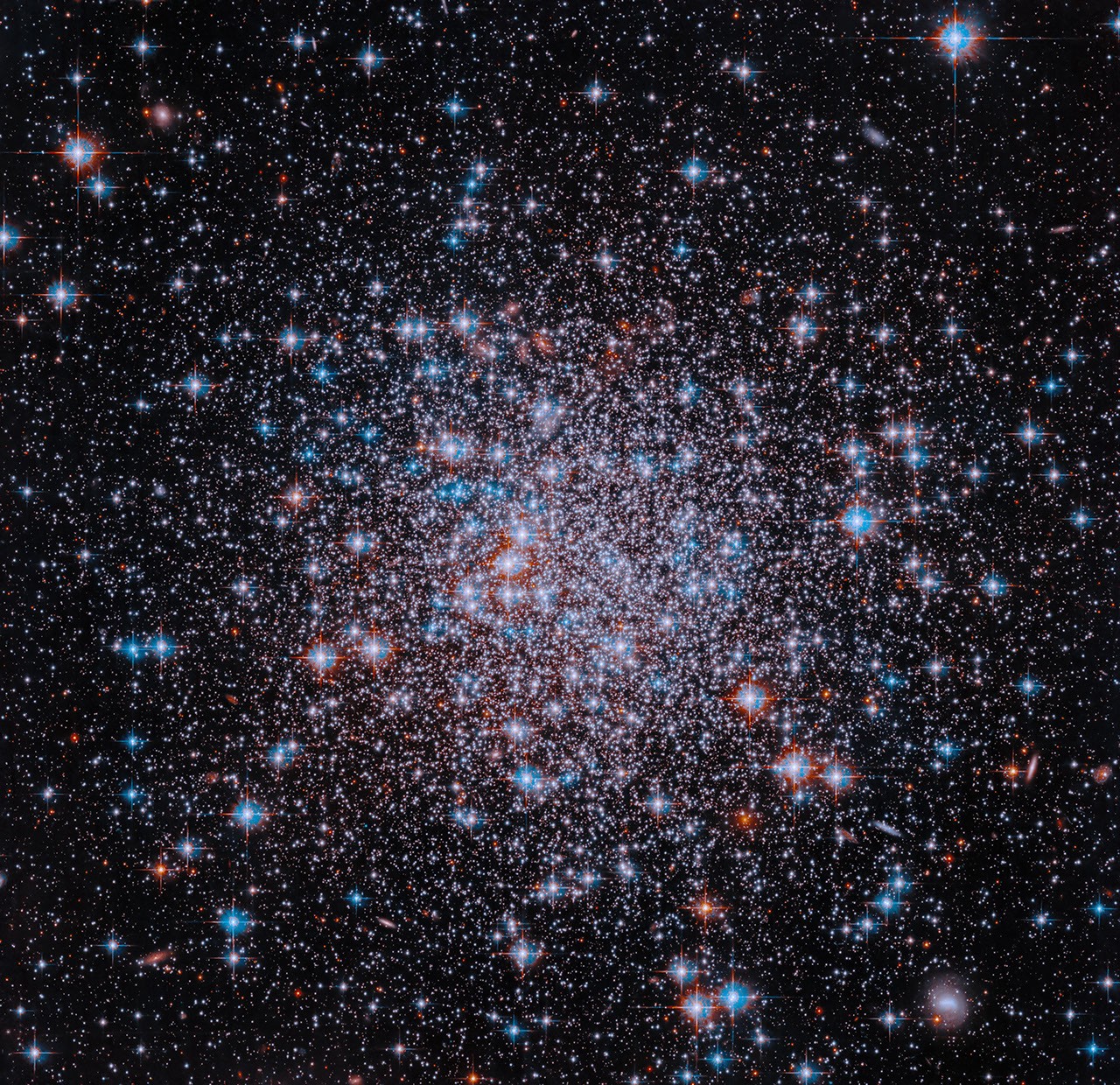
NASA's Hubble Space Telescope captured a stunning stellar cluster that resembles fireworks bursting across the darkness of space. The image reveals a dense collection of stars arranged in patterns that evoke red, white, and blue hues, creating a visual effect reminiscent of a sparkler on Independence Day.
Hubble's observations showcase the telescope's ability to resolve individual stars within crowded galactic environments. The color variations in the image stem from differences in stellar temperature and composition. Hotter, younger stars appear blue and white, while cooler, older stars display red wavelengths. This color stratification provides astronomers with clues about stellar age and evolution within the cluster.
The Hubble Space Telescope, a joint mission between NASA and the European Space Agency, has spent over three decades observing such cosmic structures. Its 2.4-meter mirror and advanced instruments enable observations across ultraviolet, visible, and infrared wavelengths, revealing details invisible to ground-based observatories. Images like this serve multiple purposes for astronomy. They help researchers study stellar populations, measure distances to galaxies, and understand the formation and dynamics of star clusters.
The sparkler comparison highlights how space exploration connects to human experience and wonder. While the resemblance to fireworks is coincidental, it underscores the dramatic visual nature of stellar systems. Each star represents a massive fusion reactor, with the brightest members potentially millions of times more luminous than our Sun.
This observation contributes to broader surveys cataloging stellar properties across the universe. By examining how stars cluster and interact gravitationally, astronomers refine models of galactic structure and stellar evolution. The data feeds into long-term research programs tracking how galaxies change over cosmic timescales.
Hubble continues operating beyond its original 15-year mission timeline, delivering discoveries that shape our understanding of stellar nurseries, galaxy formation, and the