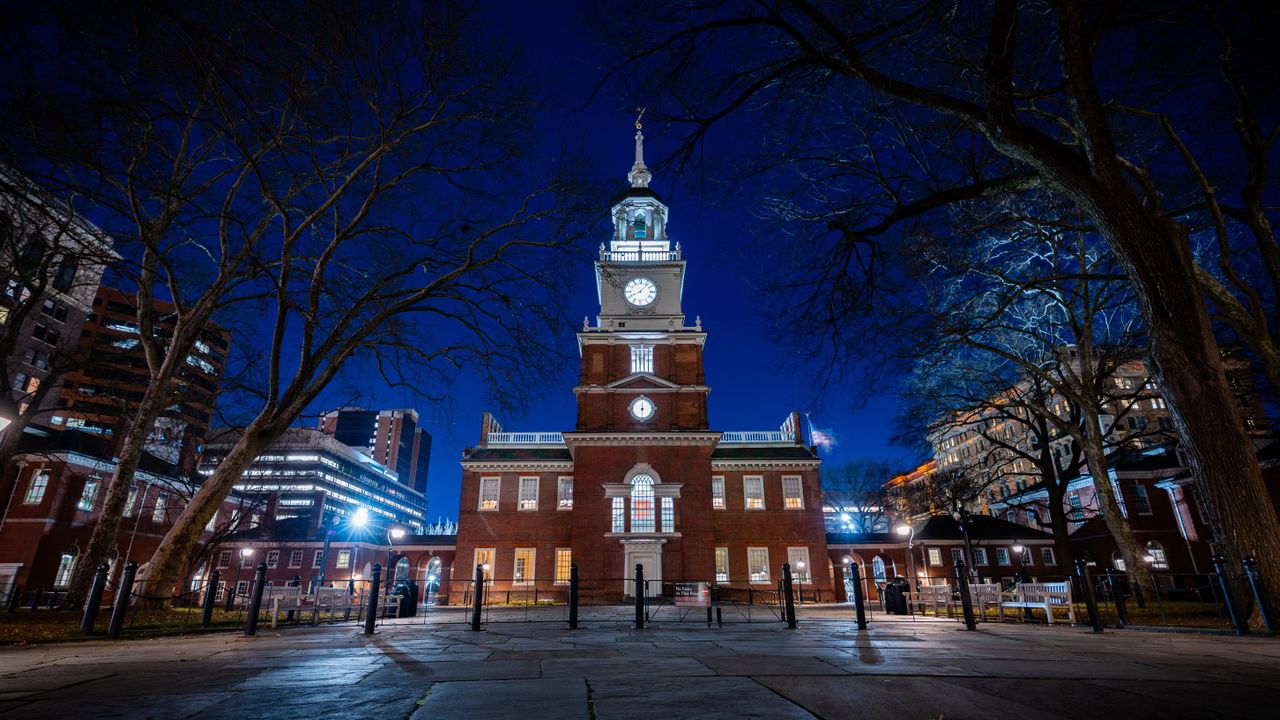
On July 4, 1776, the night sky above Philadelphia looked radically different from what modern observers see today. Benjamin Franklin and his contemporaries would have witnessed a celestial display untouched by light pollution, revealing stars invisible to most people living in cities now.
The moon was in its waning crescent phase that evening, setting early and leaving the sky dark for stellar observation. Venus dominated the western sky as the evening star, brilliant and unmistakable to colonial eyes. Jupiter and Saturn occupied the southern and eastern portions of the heavens, both visible to the naked eye as wandering stars that ancients had tracked for millennia.
The Milky Way arced across the sky in full majesty, a cloudy river of light so vivid that colonists could navigate by it. Modern light pollution has erased this view for roughly one-third of humanity. Franklin, an accomplished natural philosopher, would have recognized constellations unchanged since antiquity. Ursa Major and Minor, Orion, and Cassiopeia held the same positions they would occupy for centuries to come.
No artificial satellites crossed the heavens. No space stations orbited Earth. The sky belonged entirely to natural phenomena governed by centuries of astronomical knowledge developed by Copernicus, Galileo, and Newton.
Calculating the precise positions of celestial bodies on that specific date requires reconstructing planetary motion backward in time using modern astronomical algorithms. Planetarium software and historical star charts confirm that the configuration was unremarkable by historical standards. No comets threatened, no eclipses interrupted the celebration, no meteor showers provided spectacular shows.
Yet the absence of dramatic events underscores something profound. Those colonists gazed at the same universe that humans still observe today, separated not by changes in the cosmos but by the accumulation of our own artificial light. The stars Franklin saw remain constant reminders that the questions driving the American