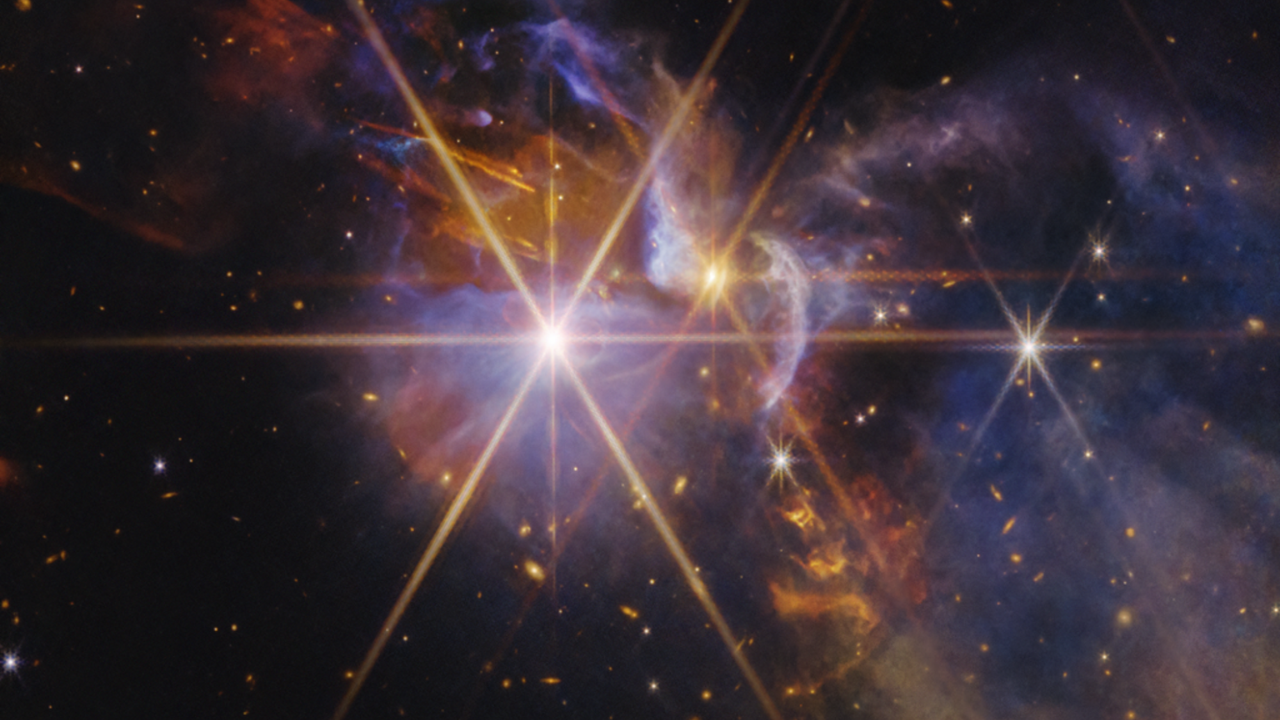
The James Webb Space Telescope has captured a spectacular image of young stars erupting with jets of material and radiation as they break free from their birth clouds. These "infant stars" fire outflows of hot gas at speeds reaching hundreds of kilometers per second, creating the luminous structures visible in the new photograph.
The image showcases a stellar nursery where gravitational collapse compressed gas and dust into protostars. As these young objects accumulated mass and began nuclear fusion, they launched powerful jets perpendicular to their accretion disks. These outflows, called bipolar jets, carve through surrounding nebular material and create the dramatic fiery displays captured by JWST's infrared instruments.
This phenomenon occurs during the T-Tauri phase of stellar evolution, when stars have not yet reached the stable hydrogen-burning main sequence. The jets serve a practical purpose in stellar physics: they carry away angular momentum that would otherwise prevent the star from contracting further and reaching the density and temperature needed for sustained fusion.
JWST's Near-Infrared Camera and Mid-Infrared Instrument proved ideal for observing these cosmic fireworks. Infrared wavelengths penetrate the thick dust surrounding star-forming regions, revealing the jets and shocks that visible-light telescopes cannot detect. The telescope's unprecedented resolution allows astronomers to measure jet velocities and compositions with clarity impossible from Earth-based observatories or even the aging Hubble Space Telescope.
Understanding stellar birth directly impacts exoplanet discovery. Protoplanetary disks orbit these infant stars during the accretion phase. The jets' influence on disk structure and stability determines which planets form and how they migrate. JWST observations of young stellar systems like this one provide essential context for understanding planetary system formation across the cosmos.
The image demonstrates JWST's transformative capacity for stellar astrophysics. Its infrared sensitivity reveals