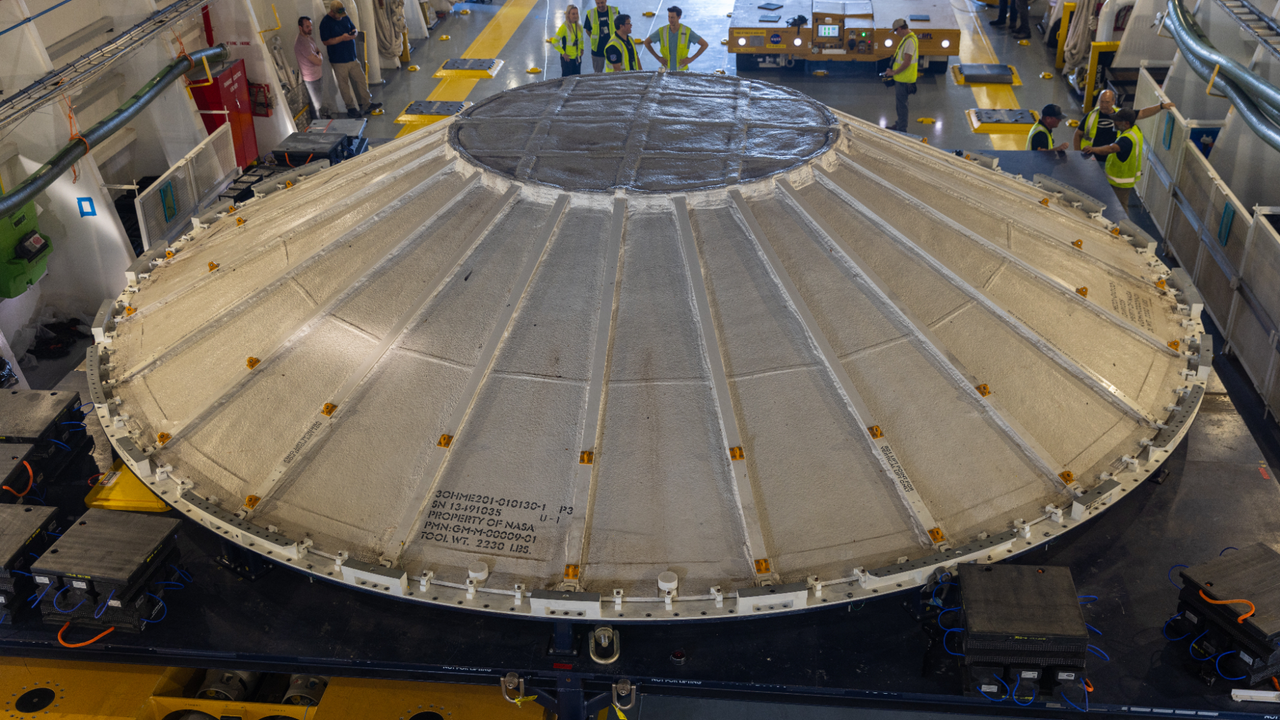
NASA received the Low-Density Supersonic Decelerator, a disc-shaped landing technology demonstrator, at its Kennedy Space Center facility on July 2, 2026. The device, colloquially dubbed a "flying saucer" for its distinctive shape, will support the Artemis 3 lunar landing mission scheduled for 2026.
The LDSD represents a critical advancement in landing systems for future crewed and uncrewed missions. Traditional parachute systems struggle with the thin Martian atmosphere and heavy payloads, making supersonic deceleration technology essential for deep space exploration. The disc design creates drag during descent, slowing spacecraft from hypersonic speeds to subsonic velocities before conventional parachutes deploy.
NASA's Space Technology Mission Directorate developed the LDSD to test inflatable aerodynamic decelerators and advanced parachute systems. These technologies have applications across multiple exploration programs, from lunar surface operations to eventual Mars missions. The system underwent several flight tests over the Pacific Ocean before selection for Artemis operations.
Artemis 3 aims to land astronauts on the lunar south polar region, where permanently shadowed craters hold water ice and other resources. The mission builds on Artemis 1 and 2, which validated the Space Launch System rocket and Orion spacecraft. Artemis 3 requires precision landing and cargo delivery capabilities that the LDSD technology enables.
The timing of the LDSD's arrival at Kennedy Space Center coincided with World UFO Day, a celebration of unidentified aerial phenomena that generated considerable public attention online. The playful connection between the disc-shaped technology and UFO imagery captured widespread interest in the space community and beyond.
NASA's continued innovation in landing systems demonstrates the agency's commitment to establishing sustainable lunar operations. The LDSD technology represents years of research and development aimed at solving