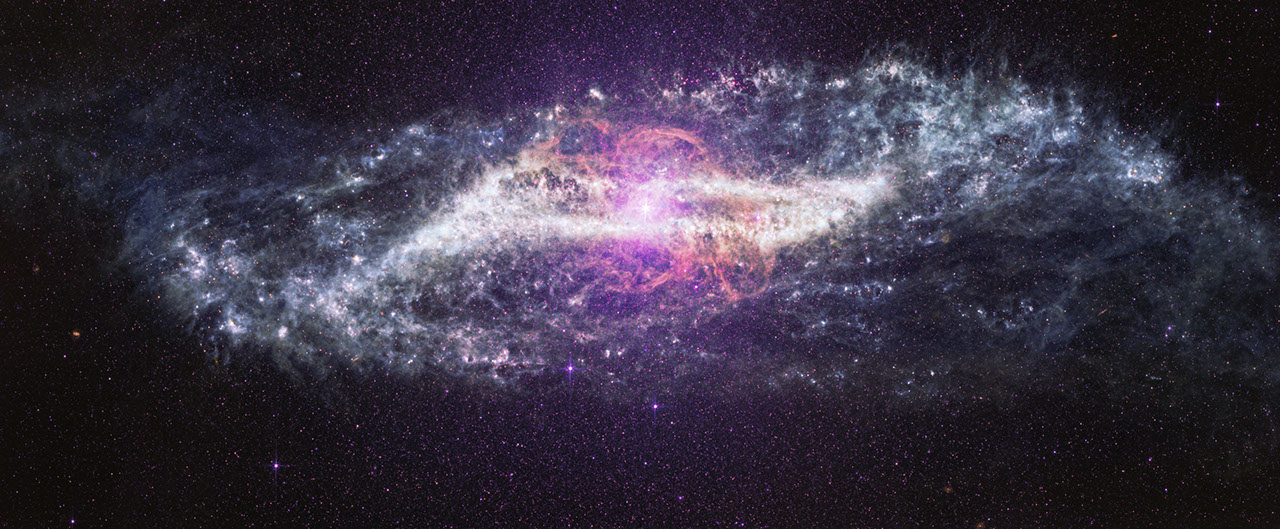
NASA's James Webb Space Telescope has revealed the hidden architecture of Centaurus A, a nearby galaxy warped by a violent cosmic collision. Webb's infrared capabilities penetrate the dust that blocks visible-light observations, exposing the galaxy's complex structure for the first time with this level of detail.
Centaurus A lies roughly 12 million light-years away and bears the scars of a merger with another galaxy billions of years ago. The collision created the distinctive dust lanes and distorted morphology that ground-based telescopes observe. Webb's sensitivity across near- and mid-infrared wavelengths strips away this obscuring dust, revealing the true scale of the disruption and the galaxy's ongoing transformation.
The images showcase Webb's core strength. Where Hubble and ground-based observatories see opaque darkness, Webb detects stellar populations, active galactic nuclei, and structural details previously hidden. The telescope's infrared instruments capture radiation from stars and hot gas that visible-light telescopes cannot access, providing a more complete census of the galaxy's content and dynamics.
Centaurus A hosts a supermassive black hole at its center, and the merger likely energized this object. Webb's observations help astronomers understand how galaxy collisions trigger black hole activity and reshape galactic structure across cosmic time. The new data constrains models of how mergers drive evolution in massive elliptical galaxies.
The observations arrive as Webb marks four years of science operations. The telescope has fundamentally transformed infrared astronomy since its December 2021 deployment, peering deeper into space and time than any previous observatory. Images like these of Centaurus A demonstrate Webb's capability to reexamine nearby galaxies with transformative clarity, revealing phenomena that shaped the local universe.
These results underscore why Webb remains essential to galactic archaeology. Understanding the mechanics of galaxy collisions like the one that created Cent