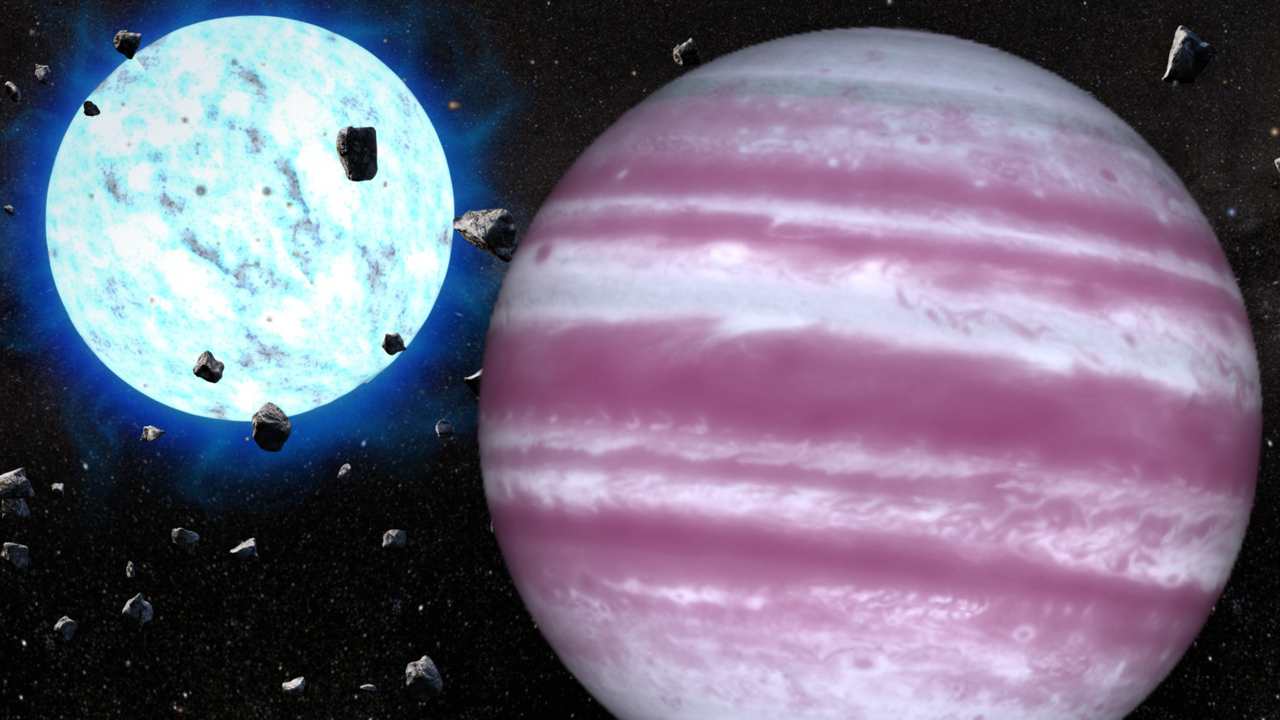
The James Webb Space Telescope has observed a white dwarf system that offers a preview of what will happen to Earth and the other planets orbiting our Sun billions of years from now. The observations reveal an exoplanet in orbit around a stellar remnant, providing astronomers with direct evidence of planetary survival after stellar death.
White dwarfs are the dense cores left behind after stars like our Sun exhaust their nuclear fuel and shed their outer layers. They represent the final evolutionary stage for roughly 97 percent of all stars in the Milky Way. The detection of an intact planet orbiting such a remnant demonstrates that worlds can persist through the violent death throes of their host stars, challenging earlier assumptions about planetary survival rates.
JWST's infrared capabilities allowed astronomers to detect the exoplanet and characterize its environment in unprecedented detail. The observations revealed dust and debris orbiting the white dwarf alongside the planet, suggesting an active planetary system still undergoing reshaping. This architecture mirrors predictions about what may occur in our own solar system when the Sun eventually exhausts its hydrogen fuel in approximately 5 billion years.
During the Sun's death, it will expand into a red giant, likely engulfing Mercury, Venus, and possibly Earth. The surviving outer planets, including Jupiter and Saturn, may be hurled into new orbits. The JWST observations suggest that some worlds could establish stable new configurations around the resulting white dwarf, fundamentally altering the solar system's architecture but allowing planetary bodies to endure.
The research carries profound implications for understanding planetary habitability and survival timescales. It indicates that the timeline for planetary evolution extends far beyond the main sequence phase of stars. The discovery also reshapes expectations about the frequency of planets orbiting white dwarfs, suggesting they are far more common than previously believed.
JWST's detection capability marks a watershed moment in exoplanet science.