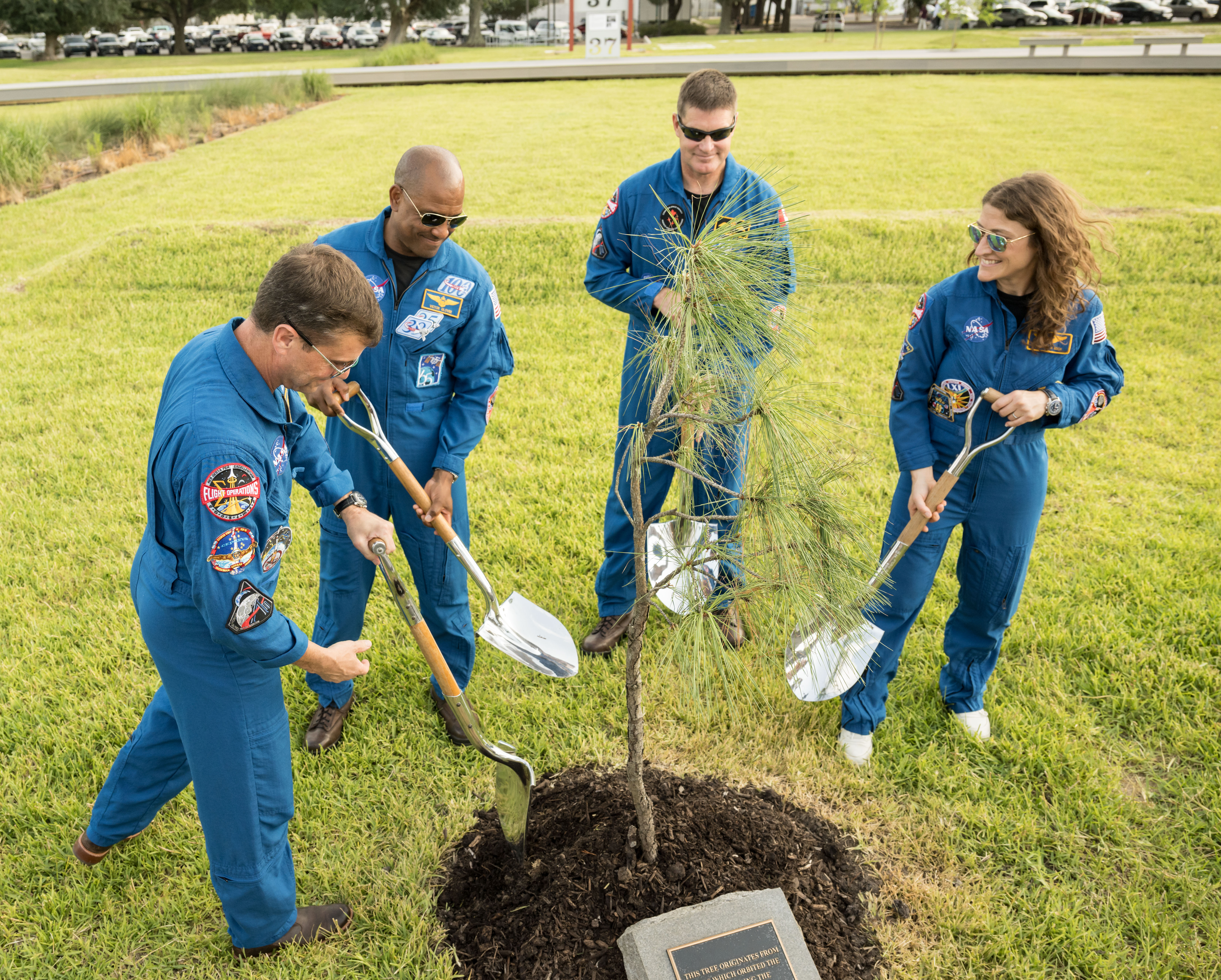
NASA's Artemis II crew gathered at Johnson Space Center on June 25, 2026, to dedicate a second-generation Apollo Moon tree at the Lunar Receiving Park. The loblolly pine descends from seeds that traveled to the Moon aboard an Apollo mission decades earlier, connecting the agency's human spaceflight heritage directly to its next chapter of lunar exploration.
The original Apollo Moon trees represent a unique artifact from the Apollo era. Seeds flew to lunar orbit aboard Apollo 14 in 1971, accompanying astronaut Stuart Roosa, who served as the command module pilot. After returning to Earth, those seeds were germinated and distributed across the United States, where they grew into mature trees. This second-generation specimen places that historical lineage into the hands of the Artemis program astronauts who will return humans to the lunar surface.
Artemis II marks the next crewed test of NASA's exploration architecture. The mission will carry four astronauts aboard the Space Launch System rocket and Orion spacecraft on a lunar flyby trajectory, validating systems and procedures before the Artemis III landing mission. By dedicating this tree, the agency anchors its deep history in lunar exploration to the team preparing humanity's return.
The gesture carries symbolic weight beyond nostalgia. The Apollo program demonstrated technical achievement and human capability at the Moon. The Artemis program extends that legacy with updated objectives: establishing sustained lunar presence, advancing scientific discovery, and preparing for eventual human missions to Mars. The Moon trees themselves survived and thrived on Earth, testifying to the resilience of biological systems and humanity's ability to bring life to the Moon and back.
The Lunar Receiving Park at Johnson Space Center serves as an appropriate venue for this dedication. The facility preserves Apollo-era heritage while supporting modern spaceflight operations. Gathering the Artemis II crew there underscores continuity: the