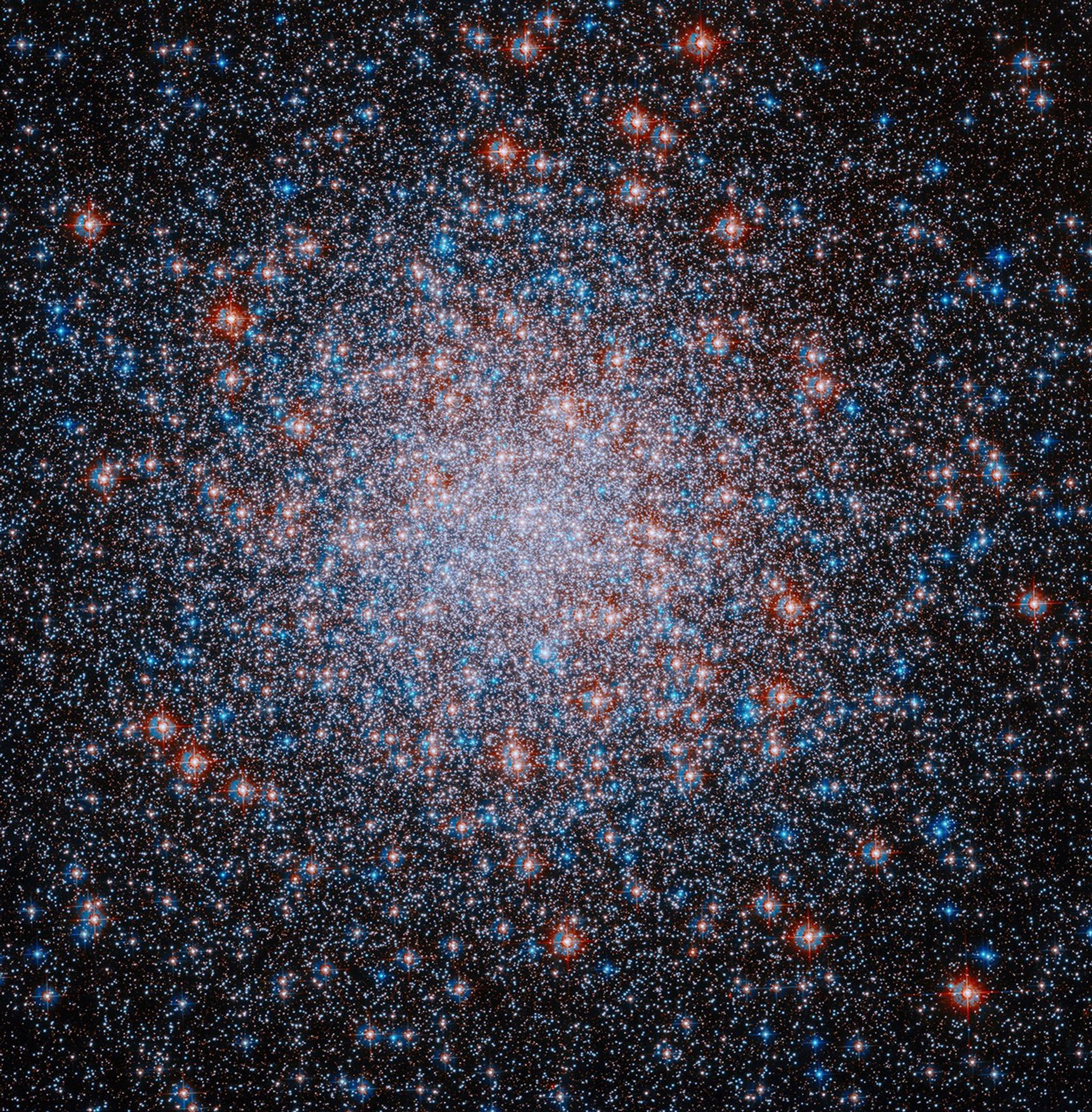
NASA's Hubble Space Telescope has captured a striking image of Messier 3, one of the Milky Way's most massive globular clusters. The photograph reveals thousands of ancient stars packed into a spherical formation held together by gravity.
Globular clusters form from single clouds of gas, creating populations of stars with remarkably similar ages. Messier 3 ranks among the largest such structures in our galaxy, containing hundreds of thousands of stars compressed into a region only about 200 light-years across. The cluster lies approximately 33,900 light-years from Earth in the constellation Canes Venatici.
These dense stellar assemblies provide astronomers with natural laboratories for studying stellar evolution. Because the stars within a globular cluster share the same age and chemical composition, researchers can observe how stars of different masses evolve over time. This makes globular clusters invaluable for calibrating cosmic distance measurements and understanding the early history of the Milky Way.
Hubble's observations of M3 reveal intricate details impossible to capture from ground-based telescopes. The image resolves individual stars across the cluster's core and outer regions, exposing the range of stellar masses and evolutionary stages present. Older globular clusters like M3 offer clues about the galaxy's formation epoch, when the universe was barely a billion years old.
The Milky Way harbors roughly 150 known globular clusters, with M3 representing one of the most thoroughly studied. Its brightness and accessibility have made it a favorite target for both professional astronomers and amateur observers for centuries. Hubble's continued observations provide unprecedented detail about the internal dynamics and stellar populations that shape these ancient cosmic structures, contributing to our understanding of galactic archaeology and the universe's oldest stellar systems.