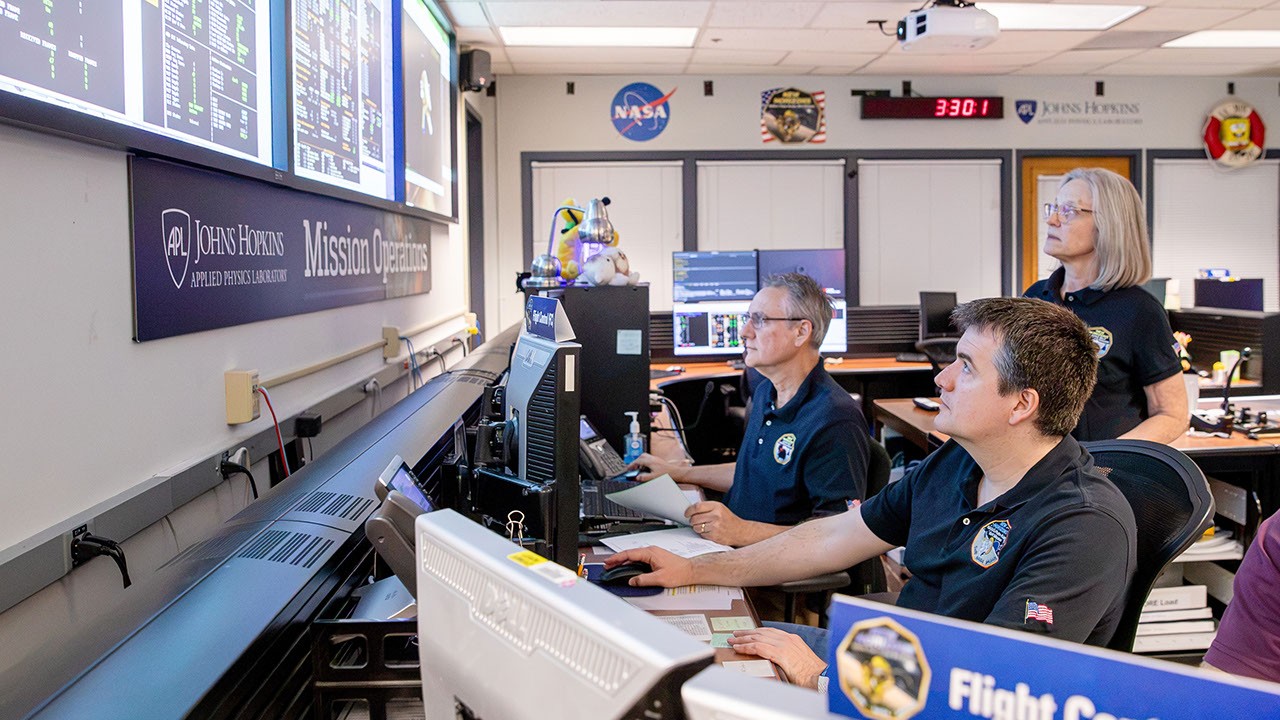
NASA's New Horizons spacecraft has awakened from hibernation and resumed full operational status after nearly a year in dormancy. Flight controllers at Johns Hopkins Applied Physics Laboratory confirmed the spacecraft's healthy systems on June 23, positioning the probe to transmit accumulated science data from its current position in the Kuiper Belt, the icy region beyond Neptune's orbit.
New Horizons executed this extended hibernation to conserve power and resources as it continues its journey through the outer solar system. The spacecraft, which conducted humanity's first close encounter with Pluto in July 2015, has spent the subsequent years exploring distant Kuiper Belt objects and gathering data on this remote region of planetary formation.
The vehicle's reactivation marks a critical milestone in its extended mission. New Horizons carries onboard instruments designed to detect energetic particles, analyze composition through spectroscopy, and photograph distant objects with precision optics. These tools have proven essential for studying the Kuiper Belt's structure, the nature of icy bodies, and the solar wind's behavior at extreme distances from the Sun.
The successful awakening demonstrates the spacecraft's robust design and the mission team's operational expertise. Managing a probe billions of miles from Earth requires careful energy management and redundant systems. New Horizons operates on power generated by a single radioisotope thermoelectric generator, making efficiency paramount during extended missions.
This hibernation period represents New Horizons' longest sleep cycle to date, testing the limits of spacecraft endurance. The successful reactivation validates NASA's approach to deep space exploration, where dormancy periods extend spacecraft operational lifespans far beyond initial mission designs.
New Horizons continues transmitting data about the Kuiper Belt's population of small icy bodies, contributing to our understanding of planetary system formation and evolution. The spacecraft's ongoing observations inform debates about how our solar system assembled and continues to evolve at its outer edges