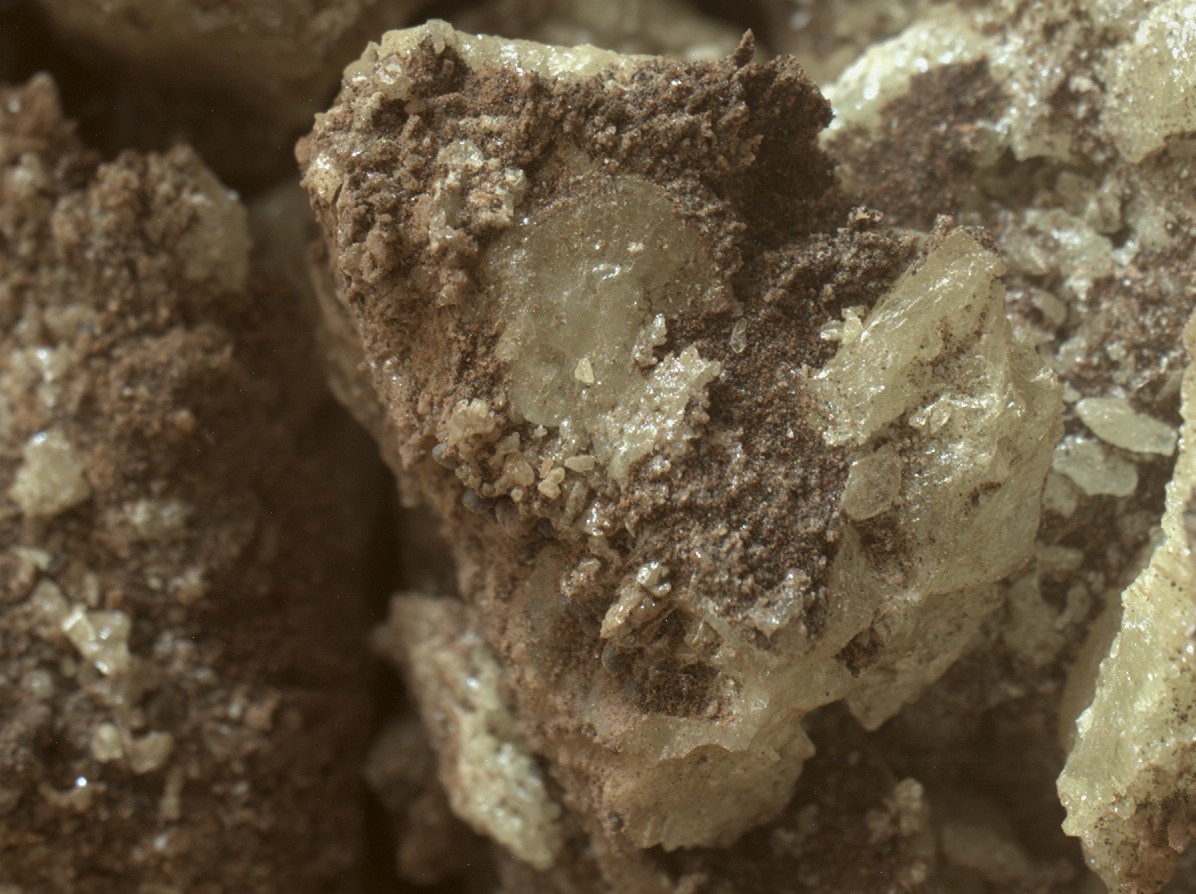
NASA's Curiosity rover discovered pure sulfur crystals on Mars for the first time, exposing the mineral after accidentally crushing a rock on May 30, 2024. The rover's robotic arm camera captured close-up images of the sulfur fragments days later, marking an unexpected find in the rover's ongoing exploration of Gale Crater.
The discovery emerged from chance rather than design. Curiosity's wheels broke open a rock during routine driving, revealing bright yellow sulfur fragments embedded within. The rover's MAHLI camera, positioned at the end of its Sample Analysis at Mars (SAM) instrument suite, documented the crystals in detail.
Pure elemental sulfur rarely appears on planetary surfaces. On Mars, sulfur typically combines with other elements to form sulfates and sulfides. Finding isolated sulfur crystals suggests localized geological processes produced this material, possibly through hydrothermal activity or chemical weathering involving sulfur-bearing rocks. The discovery refines our understanding of Mars' subsurface chemistry and past environmental conditions.
Curiosity has operated on Mars since August 2012, far exceeding its original two-year mission. The rover continues climbing Mount Sharp in Gale Crater, studying rock layers that chronicle billions of years of Martian history. Each unexpected discovery adds detail to the planet's geological story.
This sulfur find represents the kind of serendipitous science that space exploration enables. Curiosity wasn't searching specifically for pure sulfur, yet its wheels and cameras captured evidence of planetary processes that shaped Mars' interior. Such observations inform future human exploration and help scientists design better methods for detecting subsurface minerals and volatiles that future rovers and astronauts will investigate.