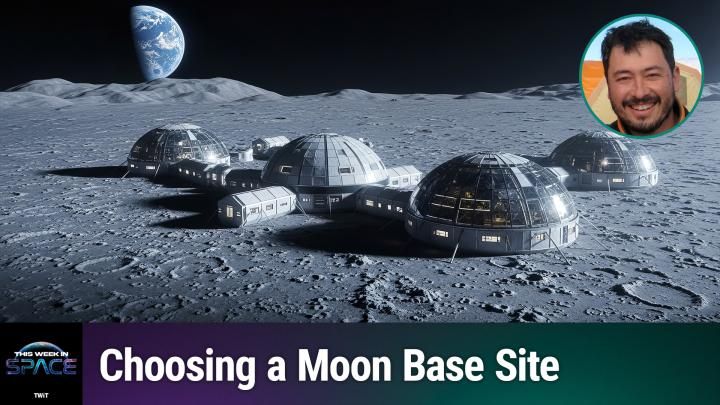
NASA is advancing concrete plans for establishing a permanent lunar base, with agency officials and planetary scientists now debating the technical architecture and location strategy for such a facility. On the latest episode of the This Week In Space podcast, host Rod Pyle and editor Tariq Malik examined these emerging plans alongside planetary scientist Pascal Lee, who brings expertise in long-term lunar habitation concepts.
The moonbase initiative represents NASA's next phase beyond Artemis, the program returning astronauts to the lunar surface for the first time since Apollo 17. Rather than brief sorties, a permanent base would enable sustained scientific research, resource extraction experiments, and preparation for eventual human Mars missions. The location decision carries substantial weight. Different sites offer distinct advantages: polar regions provide access to water ice deposits and sustained sunlight in some craters, while equatorial zones offer easier access and temperature stability.
Lee's research has focused on the engineering challenges of extended lunar stays, including habitat design, power generation, life support systems, and radiation protection. The moonbase concept builds on lessons learned from the International Space Station while accounting for the Moon's harsher environment. Surface operations at a permanent facility would support geology studies, technology demonstrations for in-situ resource utilization, and platform development for deeper space exploration.
The podcast discussion highlights how NASA's lunar strategy has evolved from early Artemis landing targets toward sustainable infrastructure. This transition demands input from planetary scientists, engineers, and mission planners. The base would likely serve as a testbed for technologies essential for Mars exploration, including long-duration life support, autonomous systems, and resource management in isolated environments.
Establishing a moonbase positions humanity for the next era of space exploration. The facility would generate data crucial for understanding the Moon's geology, mineralogy, and potential resource accessibility. More broadly, it serves as a training ground for deep space operations and demonstrates the feasibility of human presence beyond Earth orbit for extended periods.