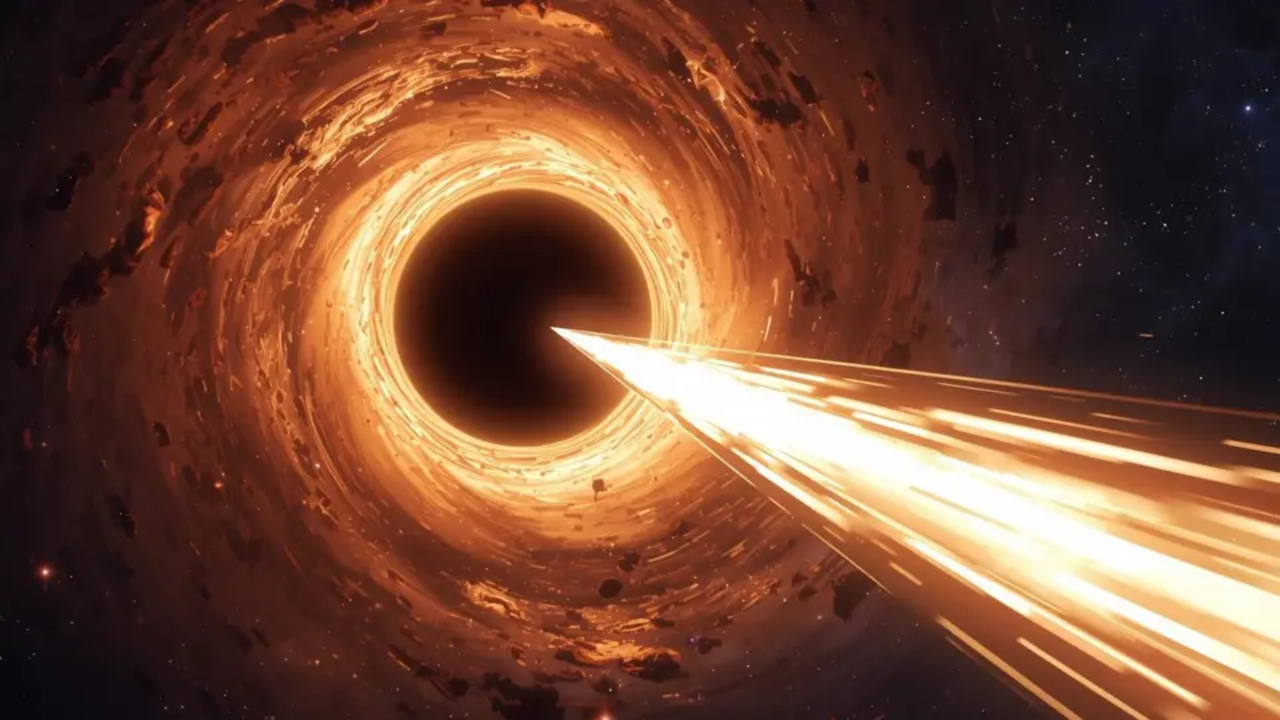
Astronomers have discovered that a supermassive black hole in a nearby galaxy displays feeding behavior identical to the most extreme objects observed in the early universe, just hundreds of millions of years after the Big Bang.
This nearby active galactic nucleus matches the ravenous consumption patterns of ultraluminous quasars detected at cosmic distances. Those ancient quasars represent some of the most energetic phenomena ever observed, yet scientists have struggled to understand how such massive black holes accumulated so much material so quickly in the young universe.
The discovery offers a rare local laboratory for studying black hole accretion physics without the complications of extreme distance and time. Astronomers can now observe this nearby feeding black hole in far greater detail than distant quasars, gathering data on how matter spirals toward the event horizon, how accretion disks generate tremendous energy, and how black holes interact with their host galaxies.
The black hole's behavior reveals the mechanisms that powered the universe's brightest objects billions of years ago. By examining this relatively close system, researchers can test theoretical models of black hole growth and accretion rates. The observations provide concrete evidence that the same physical processes governing ancient cosmic titans operate in present-day galaxies.
This work underscores how the nearby universe serves as an astrophysical testbed. Rather than relying solely on distant observations limited by redshift and faintness, astronomers leverage nearby objects as analogs for understanding cosmic history. The feeding patterns observed in this local black hole illuminate pathways for matter accumulation that shaped galaxies throughout cosmic time.
Understanding how black holes consume material at extreme rates has direct implications for galaxy evolution models. Early universe observations suggest that supermassive black holes grew faster than theory predicted. This nearby example suggests the mechanisms remain constant across cosmic time, validating approaches to modeling black hole assembly in the young universe and refining estimates of how these objects influence galactic development.