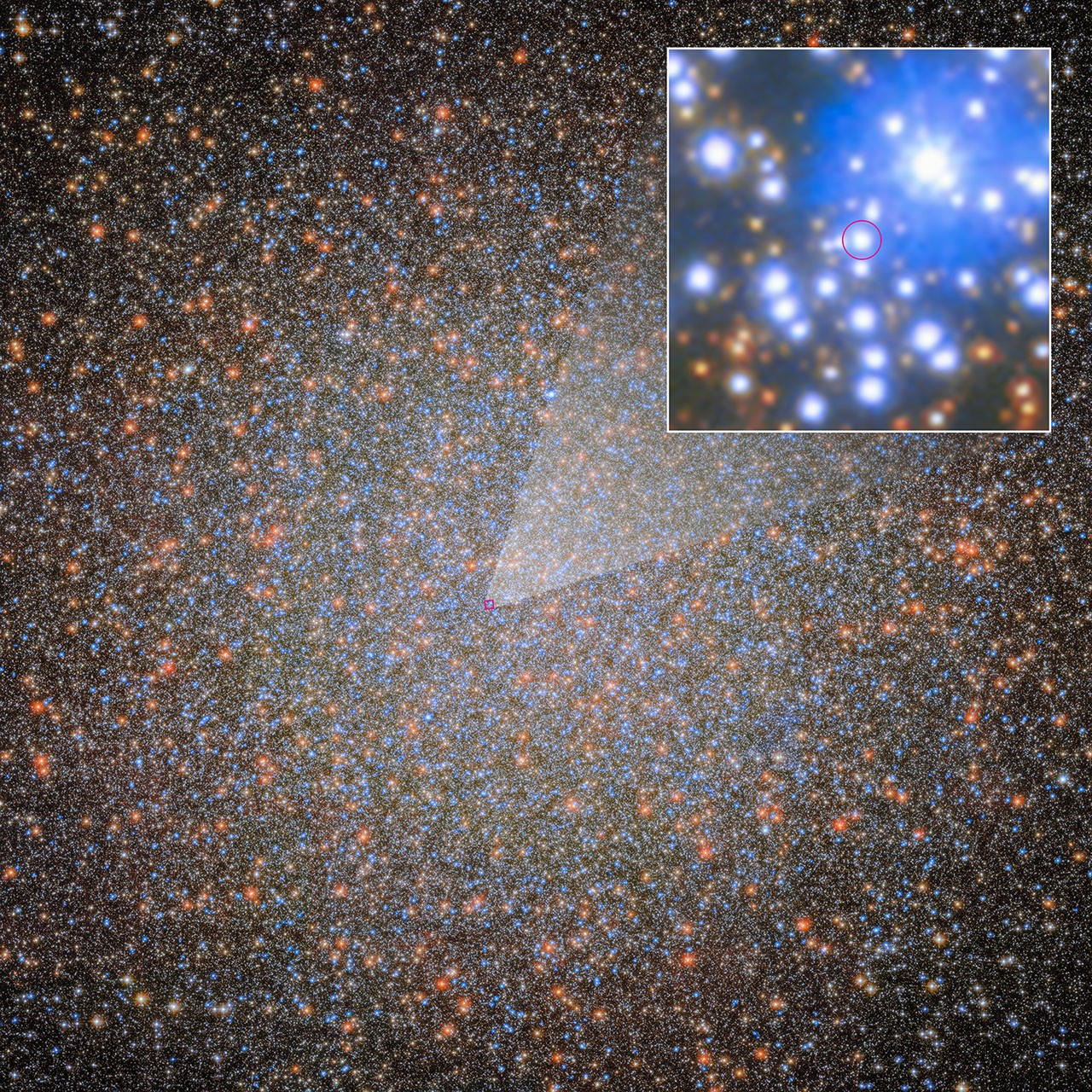
NASA's Hubble Space Telescope, working with data from the James Webb Space Telescope, has detected the first stellar-mass black hole in Omega Centauri, one of the Milky Way's most massive globular clusters. This discovery closes a long-standing gap between theoretical predictions and observational evidence.
Omega Centauri contains millions of stars packed into a region just 150 light-years across. Astronomers predicted the cluster should harbor dozens of stellar-mass black holes formed when massive stars reached the end of their lives and collapsed. Yet decades of searches turned up none. The discovery of this first black hole validates those models and opens pathways to finding its hidden counterparts.
The team used archival Hubble observations combined with supporting data from Webb to identify the black hole through its gravitational effects on nearby stars. Rather than detecting the black hole directly, astronomers measured the orbital motions of stars being pulled by its invisible gravity. This indirect method has proven essential since stellar-mass black holes lack the accretion disks that make supermassive black holes visible in other systems.
The detection matters for two reasons. First, it confirms that Omega Centauri retained its black hole population over billions of years, challenging assumptions about how these objects dynamically evolve within dense clusters. Second, it demonstrates new techniques for finding hidden black holes. As stellar-mass black holes merge and vanish into space due to gravitational interactions, finding them requires increasingly sophisticated methods.
Omega Centauri's black holes represent a distinct population from the supermassive black holes anchoring galaxy centers. Understanding their demographics and behavior refines models of stellar evolution and cluster dynamics. This single detection suggests many more await discovery in Omega Centauri and similar ancient clusters throughout the galaxy. Webb's infrared capabilities and Hubble's ultraviolet precision together created the observational synergy