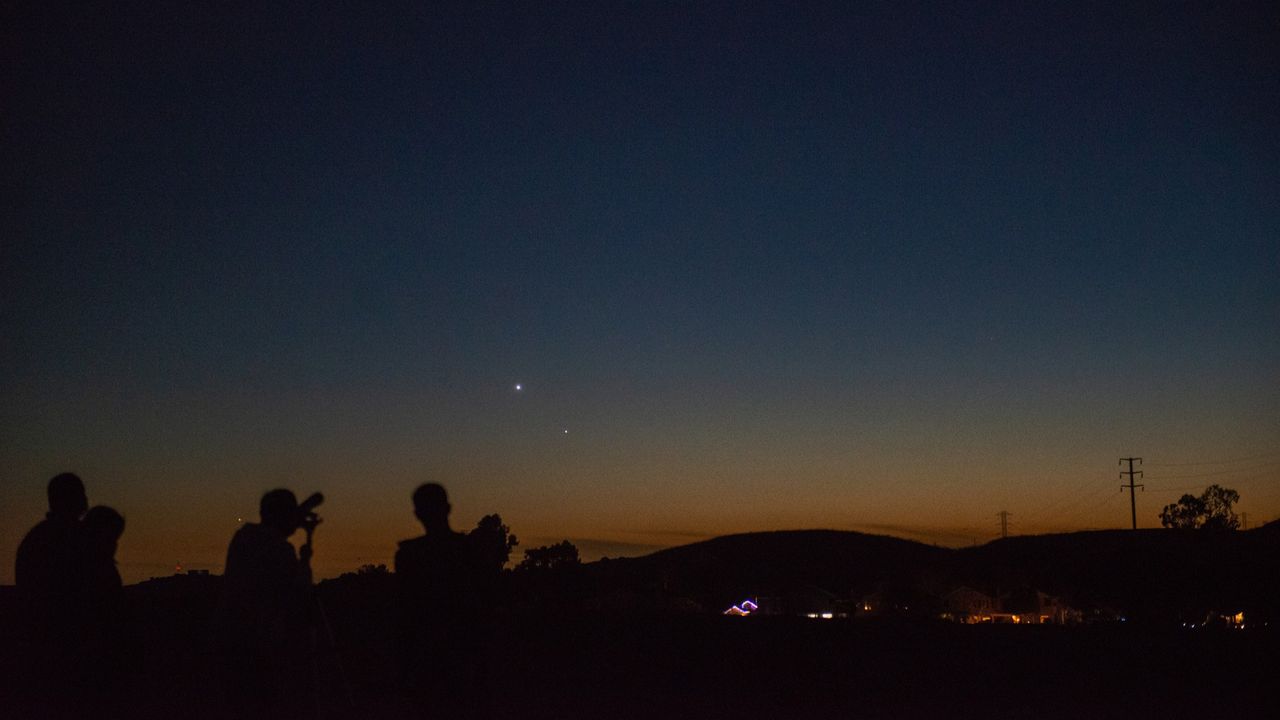
A rare celestial alignment rewards early risers on July 11 with a spectacular predawn display across the eastern sky. A thin crescent moon will appear alongside Mars, Aldebaran, and the Pleiades star cluster in a configuration that brings together planets, bright stars, and one of the most recognizable deep-sky objects visible to the naked eye.
The moon will sit low on the eastern horizon before sunrise, its slender crescent illuminated by Earth's reflected light. Mars will occupy a position near the lunar crescent, appearing distinctly reddish in the predawn darkness. Aldebaran, the brightest star in Taurus and the 14th brightest star in Earth's night sky, will complete a striking triangle with the moon and Mars.
The Pleiades star cluster, also called the Seven Sisters, will shimmer nearby. Located approximately 400 light-years away, the Pleiades spans about 13 light-years across space and contains hundreds of stars, though naked-eye observers typically resolve only six or seven of its brightest members.
Observers will need to wake before dawn and find a location with a clear eastern horizon and minimal light pollution. Binoculars enhance the view of the Pleiades and reveal additional stars within the cluster. A telescope brings the delicate nebulosity surrounding the stars into focus, showing the gas clouds that originally formed these young stars roughly 100 million years ago.
This alignment carries no astronomical significance for solar system dynamics or stellar physics. Rather, it represents a purely geometric arrangement from Earth's perspective, where the moon, a nearby planet, a relatively nearby star, and a distant star cluster all appear close together in the sky. Such lineups occur regularly as celestial bodies follow their orbital paths. These naked-eye observing opportunities provide accessible entry points for amateur astronomers and casual stargazers alike, requiring