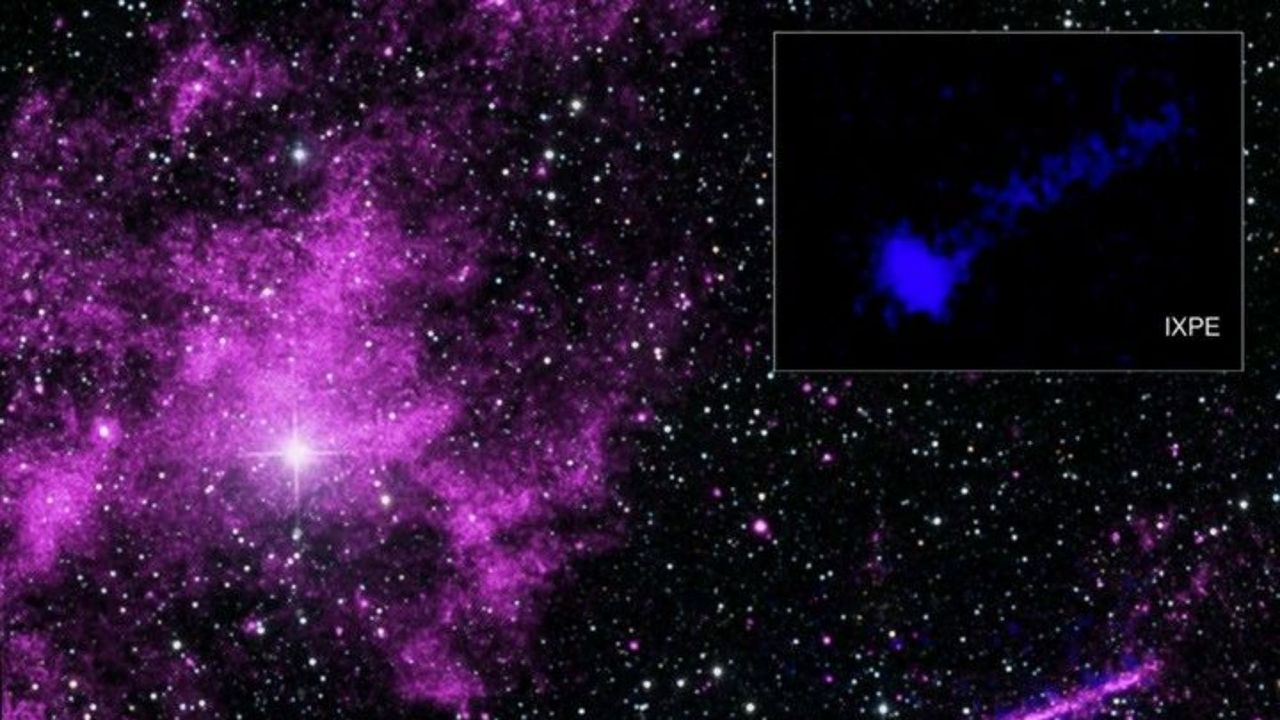
Astronomers have directly mapped the magnetic field around an extraordinary pulsar in the Milky Way, validating theoretical predictions from decades past about how particles escape from these rapidly rotating neutron stars.
Pulsars are neutron stars, the ultra-dense remnants of massive stars that exploded as supernovae. They spin at incredible speeds, some rotating hundreds of times per second, and emit beams of radiation from their magnetic poles. The pulsar in question represents one of the Milky Way's most unusual examples, possessing distinctive characteristics that set it apart from typical pulsars.
The magnetic field mapping involved direct observation of the structure surrounding the pulsar, revealing how charged particles stream outward from the star's vicinity. This phenomenon, predicted theoretically for decades, now has observational confirmation. The radiation and particle streams create what researchers describe as a "lighthouse" effect as the pulsar rotates, sweeping beams across space that Earth observers detect as regular pulses.
Understanding these magnetic field configurations holds implications for multiple areas of astronomy. The structure guides how pulsars lose rotational energy over time, affecting their evolution and longevity. It also influences the physics of the pulsar wind nebula, the expanding cloud of energetic particles surrounding the star.
The direct mapping required sophisticated astronomical observations, likely combining data from multiple observatories to reconstruct the three-dimensional magnetic architecture around the pulsar. This breakthrough demonstrates how modern instrumentation can confirm long-standing theoretical models with direct evidence rather than inference.
Pulsars serve as natural laboratories for studying physics under extreme conditions unavailable in terrestrial experiments. Neutron star material reaches densities where a teaspoon would weigh billions of tons. The magnetic fields surrounding pulsars rank among the most intense in the universe, billions of times stronger than Earth's magnetic field. These observations advance understanding of fundamental physics while mapping the structure of our galaxy.