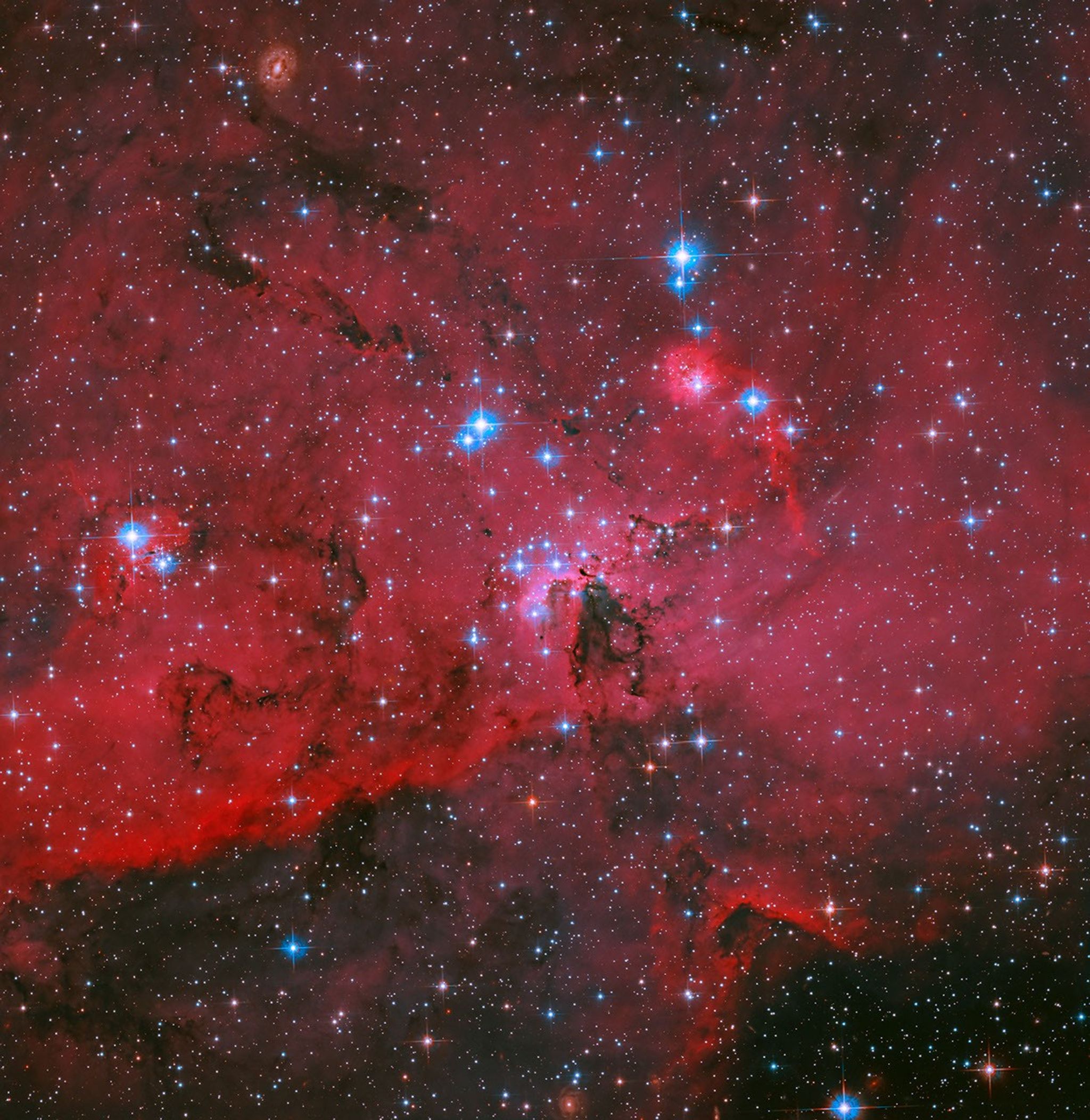
NASA's Hubble Space Telescope captured a striking portrait of stellar nursery LH 95 on July 3, 2026, revealing the violent birth processes that forge stars across the Large Magellanic Cloud. The image showcases brilliant blue and white stars embedded within crimson hydrogen gas, a stellar factory where stars of vastly different masses ignite simultaneously.
LH 95 resides within the Large Magellanic Cloud, a dwarf galaxy orbiting the Milky Way at roughly 160,000 light-years distant. This proximity makes the satellite galaxy an ideal laboratory for studying star formation in environments distinct from our own galactic neighborhood. The region displays a critical mix of low-mass infant stars alongside massive blue giants, each following different evolutionary pathways shaped by their initial mass.
The crimson backdrop consists of hydrogen gas energized by intense ultraviolet radiation from the massive blue stars. These ultraviolet photons ionize the hydrogen, causing it to glow in the distinctive red wavelengths associated with stellar nurseries. The hot, massive stars burn through their fuel rapidly, living only millions of years compared to billions for sun-like stars. Meanwhile, the lower-mass stars developing nearby will persist far longer, potentially outlasting our Sun.
Hubble's observations of such regions inform our understanding of how stars form across different cosmic environments. The Large Magellanic Cloud's lower metallicity compared to the Milky Way creates conditions that alter stellar evolution and mass distribution. By monitoring these distant stellar nurseries, astronomers refine models predicting how galaxies assemble their stellar populations across cosmic history.
The image exemplifies Hubble's enduring capacity to resolve individual stars within distant galaxies, a capability that remained unmatched until the James Webb Space Telescope entered service. These visible-light observations complement infrared observations from successor instruments, together painting a comprehensive portrait of stellar