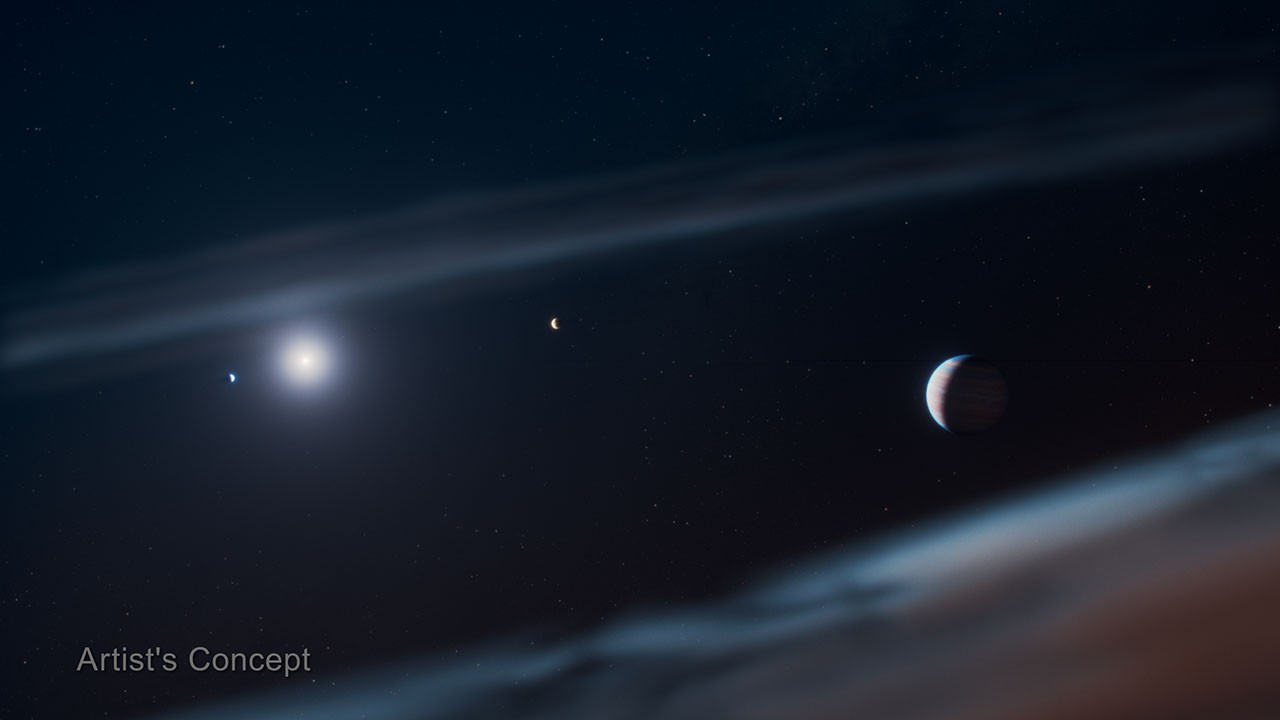
NASA's James Webb Space Telescope detected a previously unknown giant exoplanet orbiting Beta Pictoris, a young star system located roughly 63 light-years from Earth. The discovery expands the Beta Pictoris system from two known planets to three, making it one of the most populated nearby systems astronomers can observe.
Beta Pictoris b and Beta Pictoris c were already established inhabitants of this system. The newly found planet joins them in orbit around a star that remains young enough to still possess a debris disk, the leftover material from planetary formation. This combination makes Beta Pictoris exceptional for studying how planetary systems develop and evolve.
The James Webb Space Telescope's infrared sensitivity proved decisive. Webb detected heat radiating from the hidden exoplanet, revealing its presence where previous observations missed it. This capability demonstrates Webb's power for exoplanet discovery, particularly for massive worlds that emit significant thermal radiation during their early existence.
Beta Pictoris represents a laboratory for planetary science. The system's youth and proximity allow researchers to study planets still radiating heat from their formation, unlike the cooled worlds in our solar system. The debris disk surrounding the star carries signatures of planetary interactions, offering clues about gravitational dynamics between the worlds.
This discovery underscores how Webb continues rewriting the exoplanet catalog. The telescope has now identified numerous worlds missed by earlier instruments like Spitzer and ALMA. Each detection reshapes our understanding of planetary architectures and formation mechanisms across the galaxy.
The three-planet Beta Pictoris system now stands as crucial evidence that giant planets commonly form in young systems. Such configurations challenge some formation models and reinforce others. Continued Webb observations of Beta Pictoris will likely reveal further details about these worlds, including their atmospheres and compositions, advancing human knowledge of planetary diversity beyond Earth and our solar system.