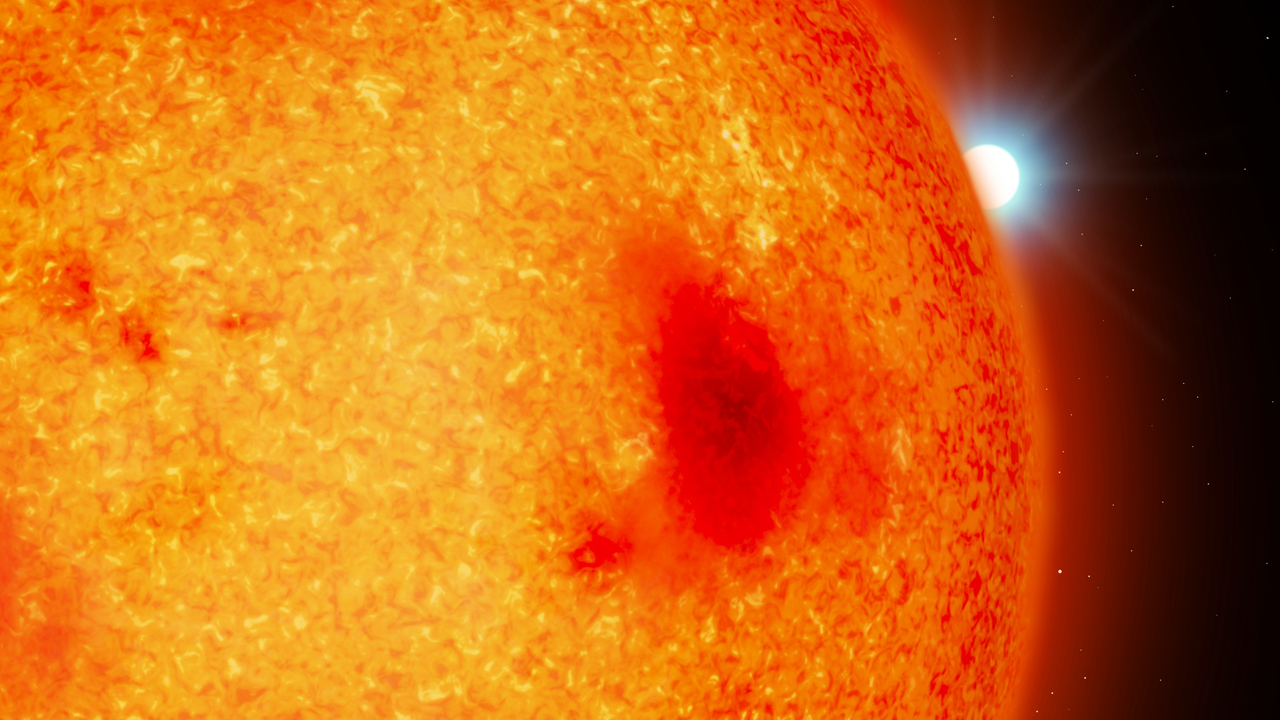
Astronomers have identified four white dwarfs orbiting red dwarf stars in systems where direct observation proved impossible. The white dwarfs remained hidden from view despite their extreme density and proximity to Earth.
White dwarfs represent the dense remnants left behind after stars like our Sun exhaust their fuel and shed their outer layers. These stellar corpses pack masses equivalent to the Sun into objects the size of Earth, creating some of the densest matter in the universe outside of neutron stars and black holes.
The discovery required indirect detection methods. Rather than observing the white dwarfs directly through telescopes, researchers analyzed the gravitational influence these objects exert on their red dwarf companions. Red dwarfs, the smallest and most abundant stars in the galaxy, provided the necessary clues. The orbital patterns and light variations from the red dwarfs revealed the presence of massive, invisible partners.
This technique exemplifies how modern astronomy overcomes observational limitations. When a nearby white dwarf hides behind a dim red dwarf star or remains obscured by dust and distance, gravitational analysis becomes essential. The researchers measured subtle shifts in the red dwarf's motion and light curves to calculate the white dwarf's mass and orbital characteristics.
These four systems expand the catalog of known white dwarfs in our galactic neighborhood. Cataloging nearby white dwarfs helps astronomers understand stellar evolution and the ultimate fate of Sun-like stars. Each discovery refines models of how binary star systems evolve and interact across billions of years.
The findings demonstrate that the observable universe still holds surprises within relatively short distances from Earth. Advanced spectroscopic analysis and photometric monitoring continue revealing stellar objects that naked observation cannot reveal. This work underscores how invisible matter, whether dark or simply obscured, dominates the cosmos in ways that require sophisticated instruments and mathematical analysis to understand.