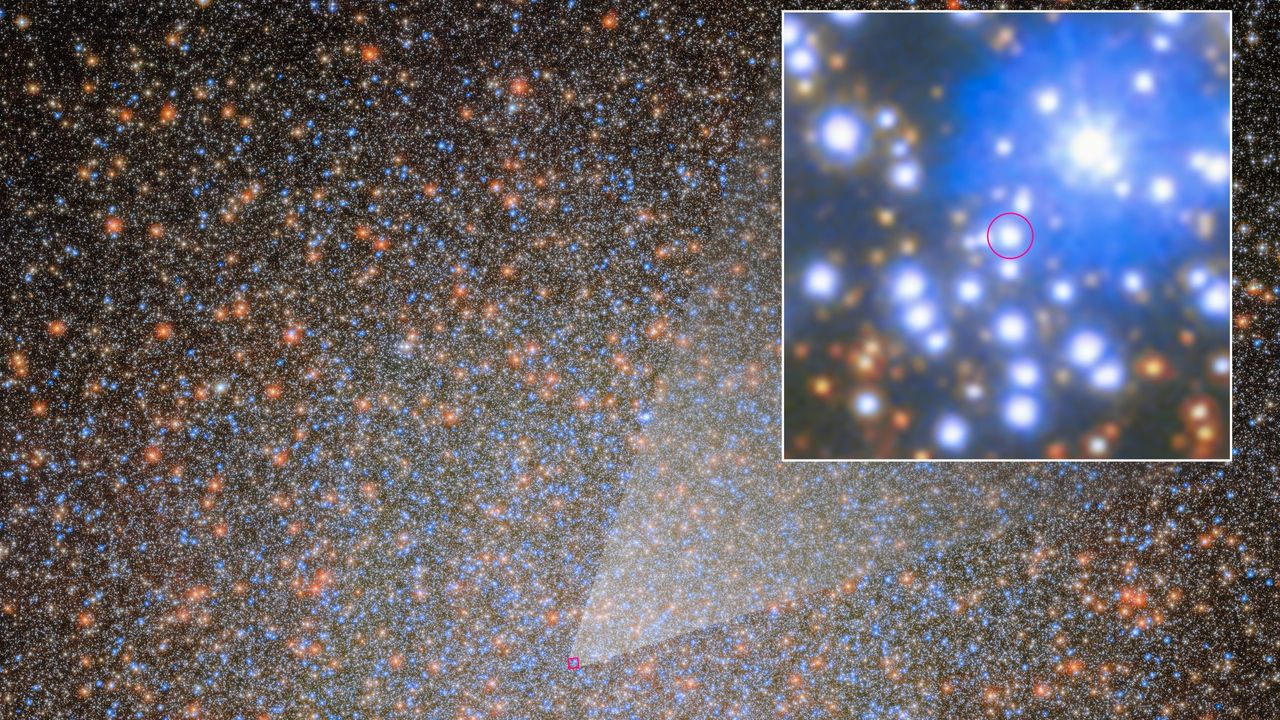
Astronomers have discovered the first of thousands of black holes hidden within Omega Centauri, one of the Milky Way's largest globular clusters, using observations from NASA's Hubble Space Telescope and James Webb Space Telescope working in tandem.
Omega Centauri contains roughly 10 million stars packed into a region only 150 light-years across. Theory predicts the cluster should harbor around 10,000 black holes based on its stellar population and age, yet astronomers have struggled to locate them. Most black holes in dense star clusters remain invisible because they do not actively accrete material from companion stars, making them essentially dark and difficult to detect through conventional methods.
The discovery marks a breakthrough in understanding black hole populations in globular clusters. By combining Hubble's visible-light imaging with James Webb's infrared observations, researchers identified a black hole that revealed itself through its gravitational influence on a nearby star. The dual-telescope approach provided complementary data that allowed astronomers to confirm the black hole's presence and measure its mass.
This finding has profound implications for stellar dynamics and black hole formation. Globular clusters represent laboratories where thousands of stars exist in close proximity, creating conditions where black holes can accumulate over billions of years through stellar collisions and mergers. Understanding the full population of black holes in Omega Centauri will refine models of how these exotic objects cluster together and interact with their stellar environments.
The remaining 9,999 black holes likely remain undetected because they orbit silently without disrupting nearby stars. Future observations and improved detection techniques may reveal more of these elusive objects. The discovery demonstrates how coordinated observations from Hubble and James Webb extend humanity's ability to probe some of the universe's most extreme objects, even when they actively resist direct observation.