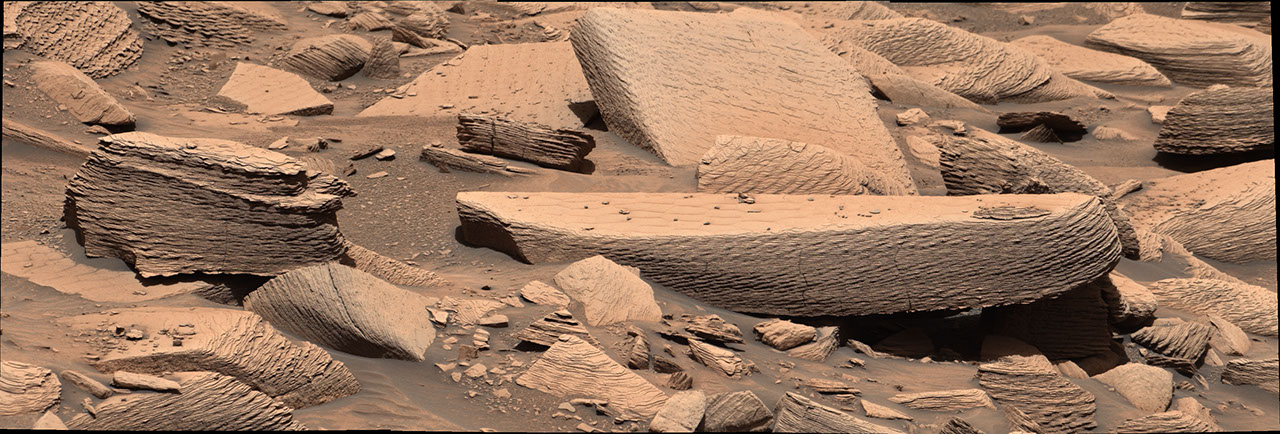
NASA's Curiosity rover has discovered geological evidence of an ancient Martian sandstorm that struck billions of years ago with enough force to stack sand ripples atop one another. The rover captured images of multilayered rock formations on December 12, 2024, during its 4,391st Martian day of operations in Gale Crater.
The formation reveals what happened during that prehistoric storm. Sand ripples moving across Mars' surface collided and climbed onto each other as wind intensified. Over geological timescales, these stacked sediment layers compacted and hardened into the stratified rocks Curiosity now observes. This type of cross-bedded rock structure acts as a record of ancient wind dynamics and sediment transport on the Red Planet.
The discovery adds to our understanding of Mars' atmospheric history. Billions of years ago, Mars possessed a thicker atmosphere capable of generating storms with sustained intensity over hours. Today, the Martian atmosphere is roughly one percent the density of Earth's, making such powerful windstorms far less common. Studying these ancient deposits helps scientists reconstruct how Mars transitioned from a warmer, wetter world with a robust atmosphere to the cold, dry planet we observe today.
Curiosity, which landed in Gale Crater in August 2012, continues its primary mission to study Mount Sharp and investigate Mars' climate and habitability history. The rover's instruments analyze rock composition, soil chemistry, and atmospheric conditions. Each finding contributes to NASA's broader exploration strategy for Mars, informing future crewed missions and long-term colonization plans.
These sedimentary layers represent more than just ancient weather. They preserve information about past surface processes, water-rock interactions, and the planet's magnetic field strength during that epoch. By reading Mars' geological record through rover observations, scientists decode the planet's evolution and assess which periods might have supported