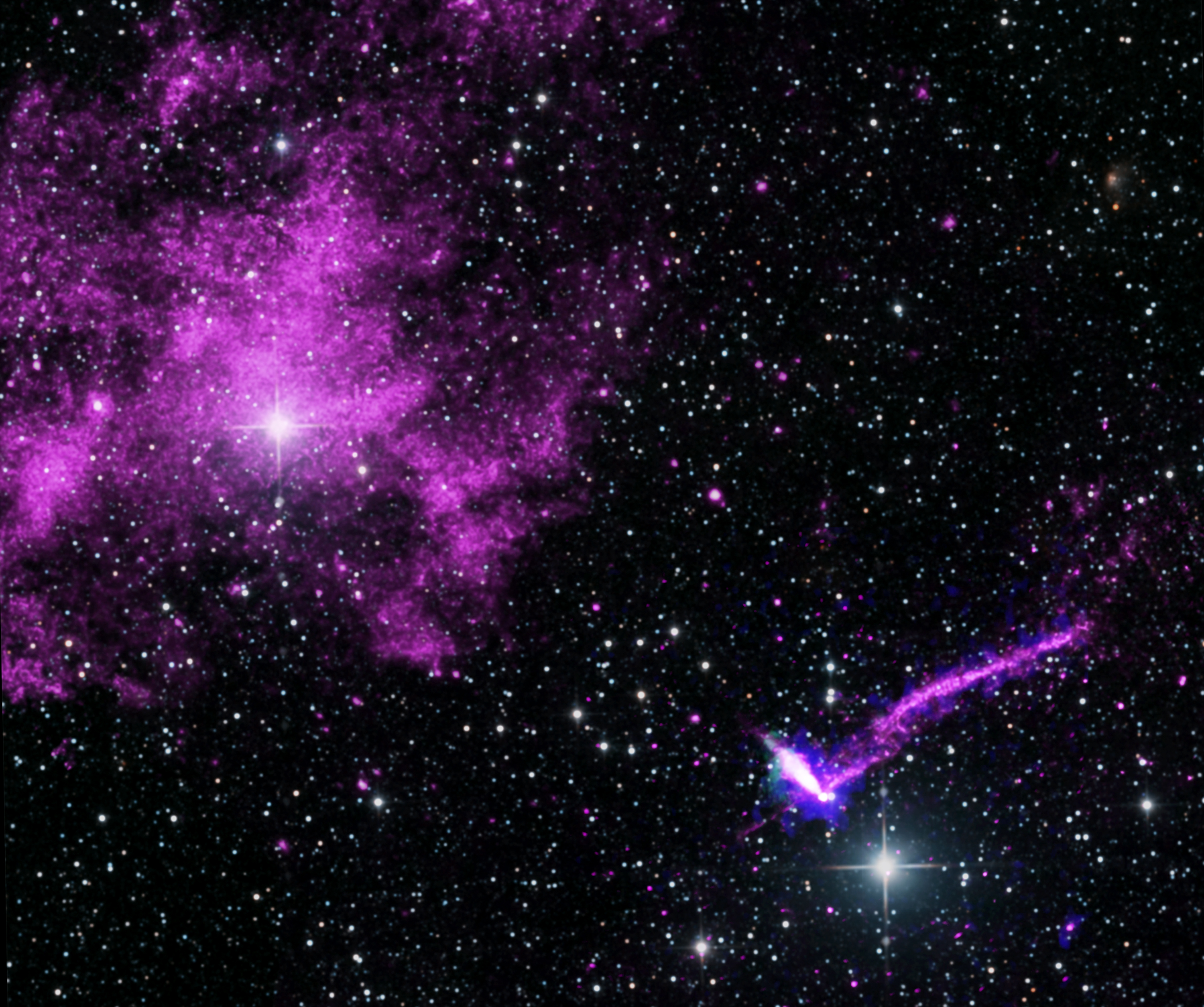
NASA's Chandra X-ray Observatory and the Imaging X-ray Polarimetry Explorer (IXPE) have combined observations to study a rapidly spinning pulsar embedded in the Lighthouse nebula. The collaboration merges Chandra's traditional X-ray imaging in purple wavelengths with IXPE's polarimetry data in blue, creating a composite view that reveals both the intensity and polarization properties of high-energy radiation from this neutron star.
Pulsars are neutron stars with extreme magnetic fields that rotate at extraordinary speeds, emitting beams of radiation like cosmic lighthouses. Understanding their behavior requires multiple observational approaches. Chandra has mapped X-ray emissions for decades, but IXPE adds a critical dimension. By measuring the polarization of X-rays, IXPE reveals the structure and orientation of the magnetic fields surrounding the pulsar, data that traditional imaging cannot provide.
This joint observation strategy addresses fundamental questions about neutron star physics. The polarization data helps astronomers map how magnetic fields channel particles and radiation around these objects. Combined with Chandra's high-resolution imaging, researchers gain unprecedented insight into the mechanisms driving pulsar emission.
The Lighthouse nebula, also known as the pulsar wind nebula surrounding this neutron star, shows the complex interaction between the pulsar's magnetosphere and surrounding material. The nebula's structure reflects decades of particle acceleration and radiation pressure from the central pulsar.
IXPE, launched in December 2021, pioneered X-ray polarimetry as a mainstream observational tool for space astronomy. Its specialized detectors measure the orientation of X-ray photons, revealing details about the extreme environments where gravity and magnetic fields dominate. Pairing IXPE's polarimetry with Chandra's established imaging capabilities creates a more complete picture of high-energy phenomena.
These observations