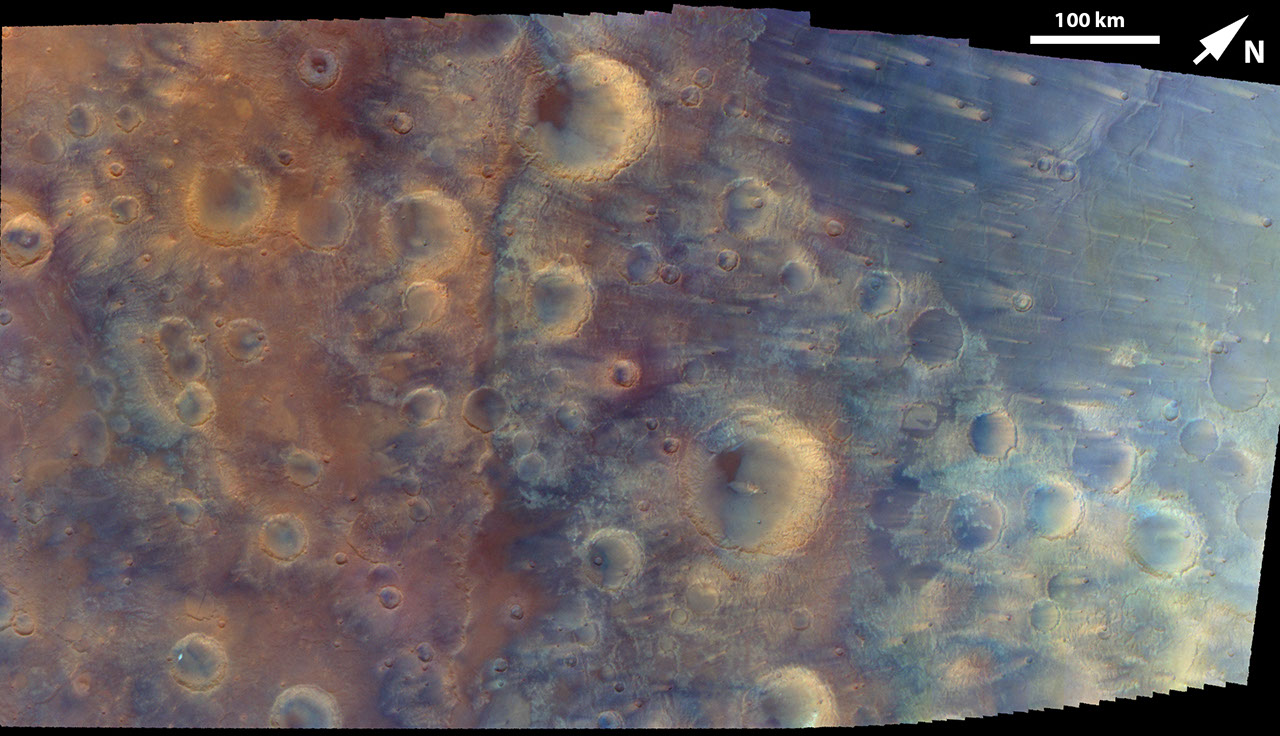
NASA's Psyche spacecraft captured detailed images of the Martian surface during a gravity assist flyby on May 15, 2026. The multispectral imager instrument aboard the mission collected four individual images across the planet's terrain in just six minutes as the spacecraft traveled northeast to southwest across Mars.
The enhanced-color mosaic reveals surface features with scientific precision, leveraging the spacecraft's sophisticated imaging capabilities designed primarily for studying the metallic asteroid 16 Psyche. This Mars encounter serves as a critical milestone in Psyche's journey to the main asteroid belt, where the mission will characterize the composition and structure of a unique M-type asteroid believed to represent the exposed iron core of a proto-planet.
Gravity assist maneuvers like this one enable spacecraft to gain velocity without expending fuel, allowing missions to reach distant destinations. The Mars flyby redirects Psyche toward its primary target in the asteroid belt, scheduled for arrival in 2029. NASA's decision to acquire these detailed images demonstrates the mission's commitment to gathering scientific data whenever possible during transit operations.
The Psyche mission represents a fundamental departure from typical planetary exploration. Rather than studying worlds that harbor potential for life or human settlement, Psyche investigates planetary formation through the lens of extreme planetary science. The asteroid 16 Psyche orbits between Mars and Jupiter and measures roughly 226 kilometers across. Its composition suggests it could expose the metallic interior of a differentiated protoplanet that lost its rocky mantle through ancient collisions.
By studying 16 Psyche's magnetic field, mineral composition, and density, the mission will test theories about planetary cores and help scientists understand how rocky planets like Earth developed their internal structure. The spacecraft will spend approximately 26 months orbiting the asteroid, progressively lowering its altitude to gather increasingly detailed observations.
These Mars images showcase the versatility of space instruments