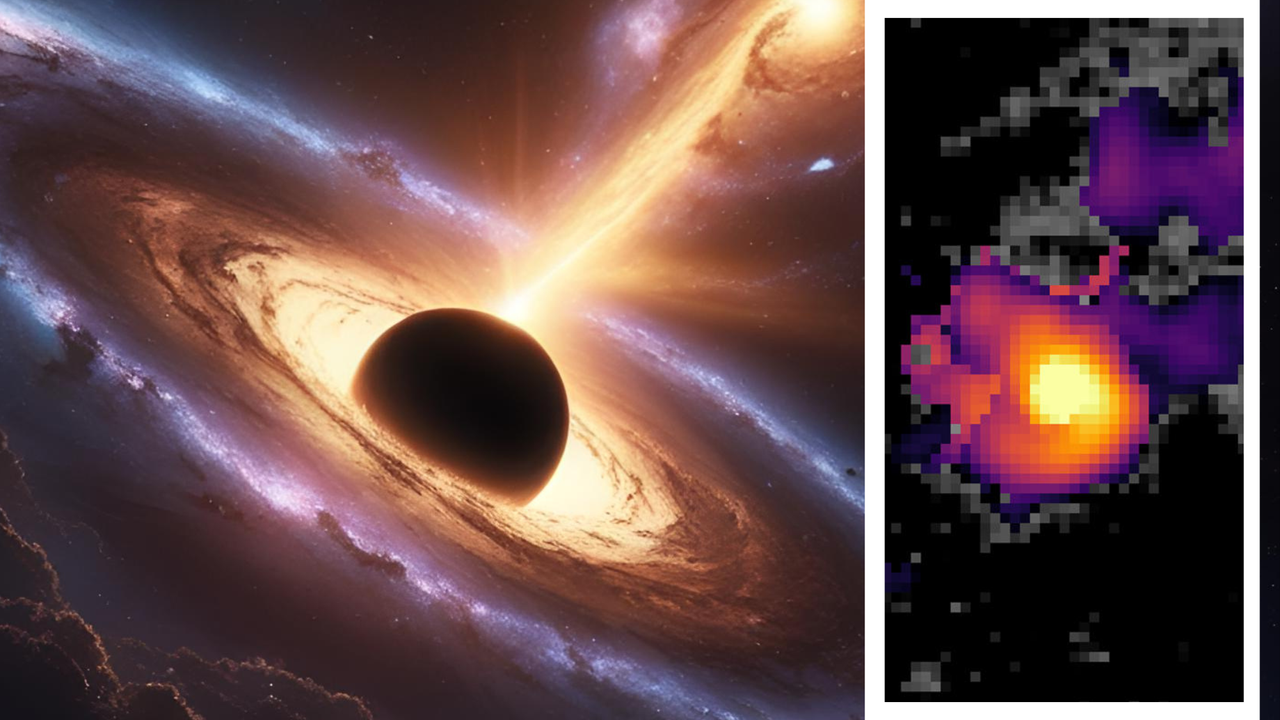
The James Webb Space Telescope has captured direct evidence of how supermassive black holes consume material from their surroundings, revealing the feeding mechanisms of the universe's most extreme objects.
Astronomers using JWST detected the specific processes by which black holes accrete gas and dust from nearby galaxies and stellar material. These observations pierce through cosmic dust that ground-based telescopes cannot penetrate, exposing the violent dynamics occurring near black hole event horizons.
Black holes grow by pulling in surrounding matter through gravitational force. This process generates tremendous heat and radiation as material spirals inward, often creating brilliant accretion disks visible across multiple wavelengths. JWST's infrared capabilities allow researchers to study these regions with unprecedented clarity, revealing how matter organizes itself before crossing the point of no return.
Understanding black hole feeding mechanisms carries profound implications for astrophysics. The rate at which supermassive black holes consume material directly influences the evolution of their host galaxies. Rapid accretion episodes trigger outflows of energy that shape galactic structure, regulate star formation, and redistribute elements throughout space. JWST observations help astronomers quantify these feedback loops and determine how black holes and galaxies coevolve across cosmic time.
The telescope's infrared sensitivity proves critical here. Traditional observations often miss the dust-obscured regions where much of this accretion activity occurs. JWST's instruments penetrate these dusty clouds, revealing active black holes that previous surveys classified as dormant or missed entirely.
These findings refine models of black hole formation and growth across the universe's history. Early observations from JWST have already surprised astronomers by detecting unexpectedly massive black holes in the young universe, just a few hundred million years after the Big Bang. Understanding how these objects feed themselves helps explain how they accumulated such enormous masses so quickly.
The James Webb Space Telescope continues to revolution