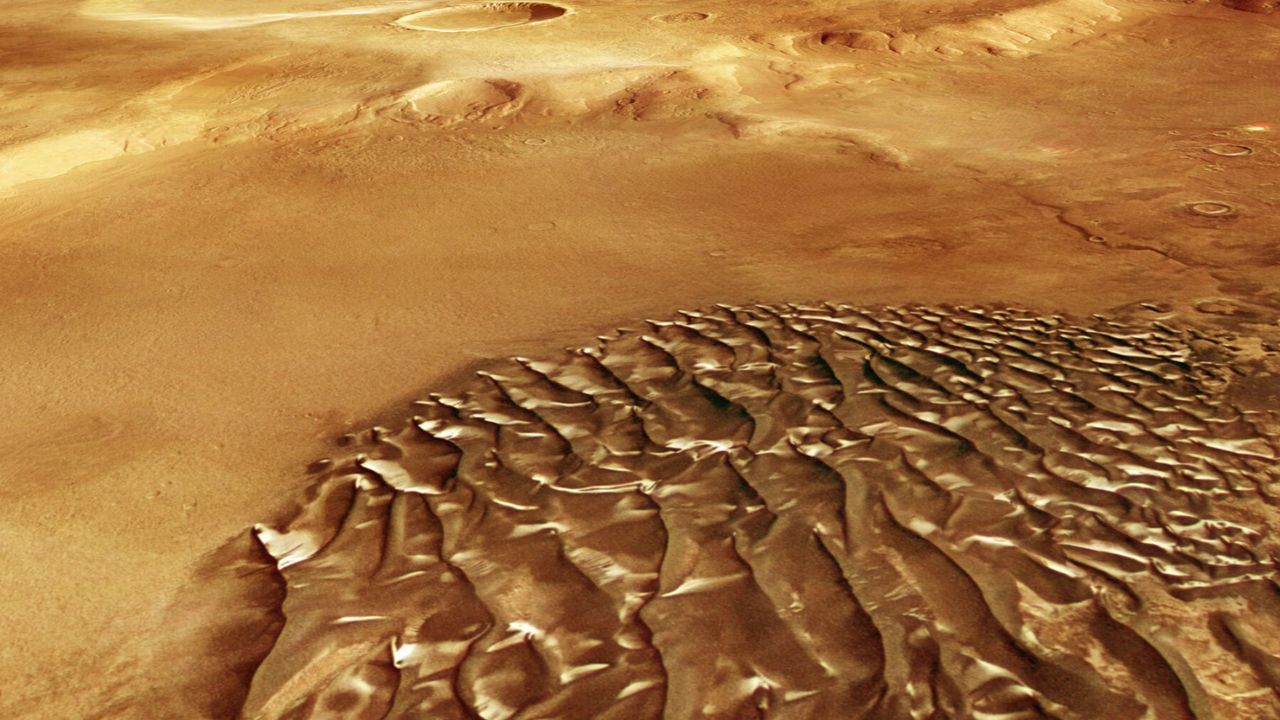
Mars Express has imaged unusual wave formations on Mars that resemble metallic or rippled surfaces. These striations captured by the European Space Agency's orbiter reveal the dynamic geological processes sculpting the Martian landscape.
The wavelike patterns appear as dark and light bands across the dune fields, creating an effect that resembles brushed metal or organized ripples. Scientists attribute this appearance to wind erosion and sand transport across Mars' surface. The planet's thin atmosphere, combined with seasonal temperature variations, creates powerful dust storms that reshape dunes over time.
These formations likely result from saltation, a process where wind lifts grains of sand and bounces them across the surface. As grains accumulate in specific patterns, they form ridges and troughs aligned perpendicular to the prevailing wind direction. The "metallic" appearance stems from how different grain sizes reflect sunlight, with coarser materials appearing brighter than fine dust.
Mars Express, which has orbited the Red Planet since 2003, continues to provide high-resolution imagery that reveals Martian geology in unprecedented detail. The orbiter's High Resolution Stereo Camera captures these formations with enough clarity to study wind patterns and dune evolution across different regions.
Understanding Martian dunes matters for multiple reasons. Future rovers and human missions require knowledge of terrain hazards and trafficability. The dune formations also serve as records of Mars' climate history, showing how wind patterns have changed over millennia. Fine sand particles in dunes can preserve organic compounds or biosignatures if microbial life ever existed on Mars.
These particular formations demonstrate how planetary atmospheres, even thin ones like Mars', actively reshape terrain. The Red Planet remains geologically dynamic, with dunes migrating measurably between orbiter passes spanning years. This ongoing landscape evolution provides clues about past habitability and current environmental conditions that future exploration missions must navigate.