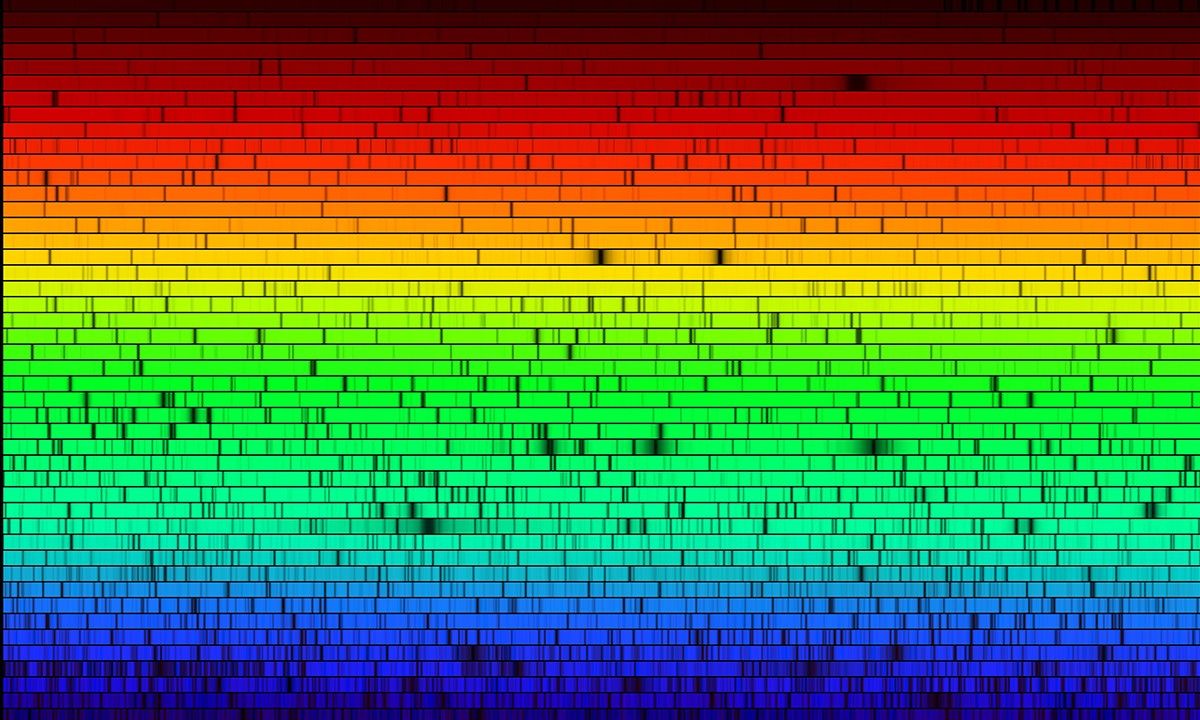
Astronomers resolved a persistent mystery about the composition of the Sun by refining models of its atmosphere. The puzzle centered on a discrepancy between the amount of silver detected in the Sun and the amount found in meteorites, which scientists use as benchmarks for the solar system's primordial composition.
Previous calculations underestimated solar silver content by 55 percent. Researchers discovered this not through new observations but by constructing a more physically accurate model of the Sun's outer layers. The revised atmospheric model accounts for complexities in how atoms and ions interact with light at different temperatures and densities.
Astronomers determine stellar composition by analyzing absorption spectra, the dark lines crossing the Sun's light as atoms in its outer atmosphere absorb photons at specific wavelengths. Each element produces a unique fingerprint of lines. The challenge lies in converting those spectral signatures into accurate abundance measurements, a process requiring precise knowledge of how atoms behave under solar conditions.
Meteorites preserve material from the early solar system, offering a reference standard for elemental abundances that should match the Sun's composition. The silver discrepancy suggested either the Sun contained far less silver than theory predicted or the measurement methods needed revision. The atmospheric model improvement resolved the tension.
This finding highlights a recurring theme in astronomy. Breakthrough discoveries often emerge not from novel instruments or data but from deeper analysis of existing information. As computational power increases and physical understanding improves, scientists can model stellar atmospheres with greater fidelity, revealing truths hidden in decades-old measurements.
The revised solar composition carries implications beyond silver. Corrected abundance estimates for all elements tracked through spectral lines improve our baseline understanding of the solar system's starting composition. This baseline informs models of planetary formation, stellar nucleosynthesis, and the chemical evolution of galaxies. Even modest corrections to fundamental solar properties ripple outward through astrophysics and planetary science, ref