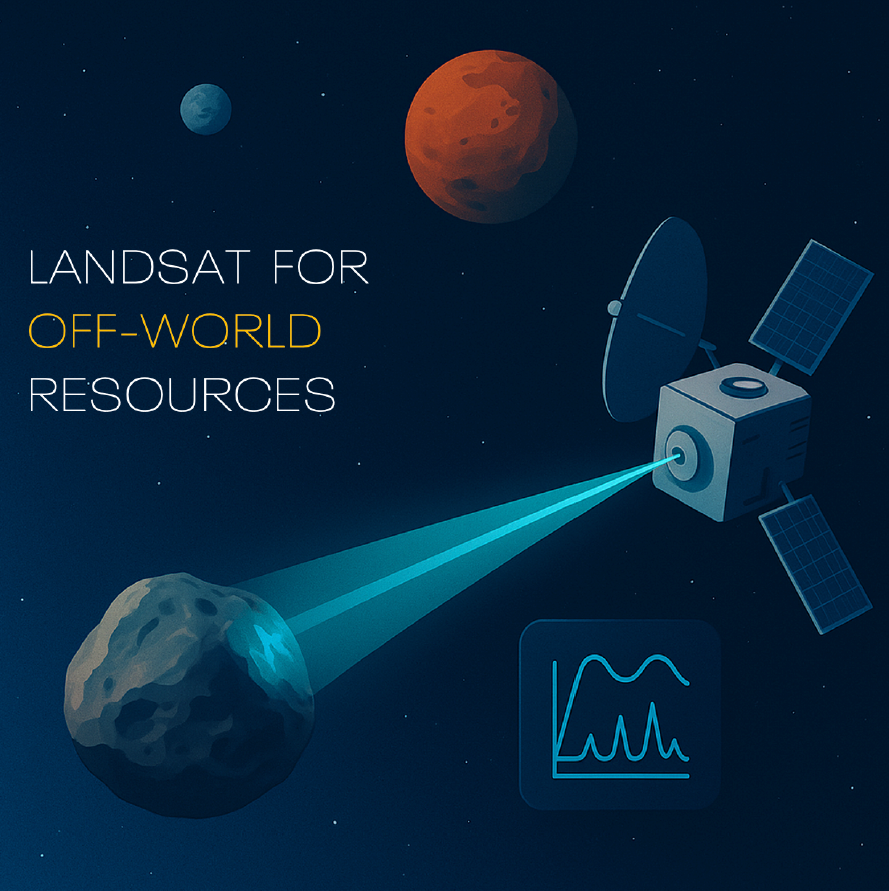
NASA explores a reconnaissance spacecraft design that performs rapid orbital surveys using Raman spectroscopy during high-speed planetary flybys. The concept, developed by Pablo Sobron Sanchez at the SETI Institute, eliminates the need for landing, sample return, or extended orbital operations that typically constrain resource exploration missions.
Raman spectroscopy identifies minerals by measuring how light scatters when molecules absorb and re-emit energy. The technique works effectively from orbit, allowing spacecraft to map subsurface composition without touching down. This approach targets three exploration priorities. At the Moon, surveys would identify ice deposits and ilmenite concentrations crucial for future human settlement and in-situ resource utilization. At asteroids, orbital spectroscopy would characterize ore content for potential mining operations. At Mars' moons, Phobos and Deimos, the spacecraft would detect volatile-bearing minerals that inform Mars science strategy.
The "interworld slingshot" design leverages gravitational assists to reduce fuel requirements and accelerate between targets. Multiple flybys per mission expand survey coverage compared to conventional approaches. Because the spacecraft maintains velocity throughout reconnaissance passes, operational costs drop substantially relative to landing-and-sample-return architectures. Mission duration compresses from years to months for comparable data collection.
This concept addresses a gap in NASA's exploration pipeline. Current methods either rely on surface operations with high mass and complexity, or on distant remote sensing with limited spectral resolution. The flyby reconnaissance approach offers intermediate capability at lower cost, enabling faster iteration on target selection for eventual landing sites or mining assessments.
Raman spectroscopy from orbit remains technologically proven but operationally novel for this application. The SETI Institute proposal advances feasibility studies toward demonstration missions. Success would transform how NASA evaluates resource availability across the inner solar system, accelerating decisions about where humans and robotic systems should focus sustained