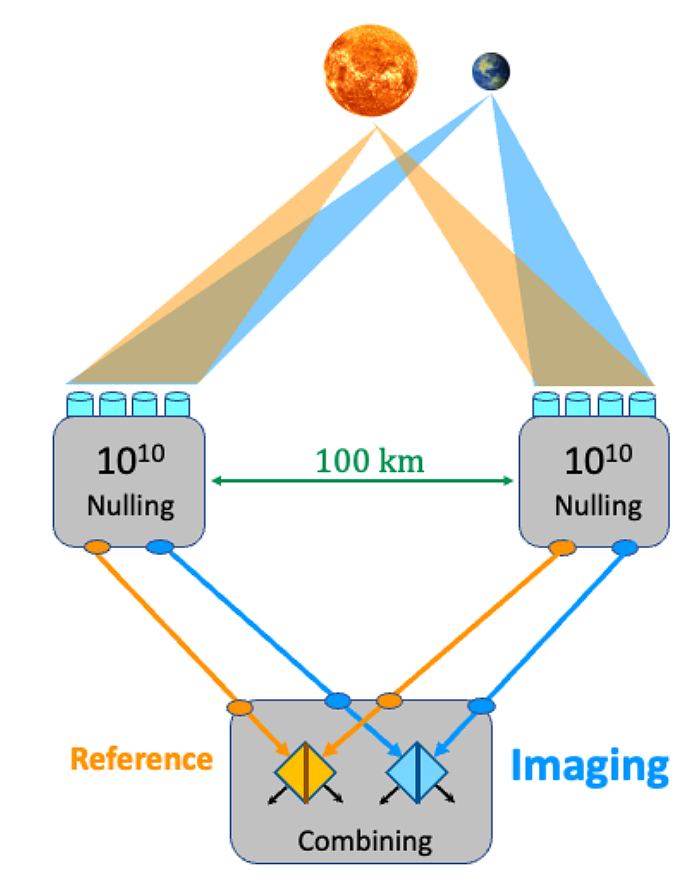
Astronomers are developing a revolutionary imaging technique to directly observe surface features on Earth-like exoplanets orbiting nearby stars. Researchers at Brookhaven Science Associates propose using optical Very Long Baseline Interferometry (VLBI) paired with a novel "dynamic hierarchical nulling" interferometer design to achieve this unprecedented resolution.
The method combines light collected from multiple telescopes spread across vast distances, effectively creating a virtual instrument with extraordinary magnifying power. By carefully filtering out starlight that overwhelms reflected planetary light, the nulling interferometer suppresses the host star's glare by factors of millions. This allows astronomers to detect and resolve the faint glow reflecting from exoplanet surfaces.
Current exoplanet detection relies on indirect methods. Transit photometry measures dips in starlight as planets cross in front of their host stars. Radial velocity techniques detect gravitational wobbles in stellar motion. These methods reveal a planet's existence and basic properties but provide no direct images. The proposed optical VLBI approach would change that fundamentally.
Direct imaging of exoplanet surfaces opens transformative science. Astronomers could map continents and oceans on distant worlds. Spectroscopic analysis of surface features would reveal composition and potentially detect biological signatures. Clouds, ice caps, and atmospheric circulation patterns become observable data rather than speculation.
The technical challenge is formidable. Earth-like exoplanets orbiting nearby stars still subtend incredibly small angles from Earth's perspective. Creating optical VLBI networks with sufficient baseline length and precision requires coordinating observations across multiple ground-based observatories or eventually space-based systems. The dynamic hierarchical nulling design offers a pathway to achieve the necessary contrast ratios and angular resolution.
Current space missions like NASA's James Webb Space Telescope achieve exoplanet spectroscopy but lack the resolving power for surface imaging. The proposed