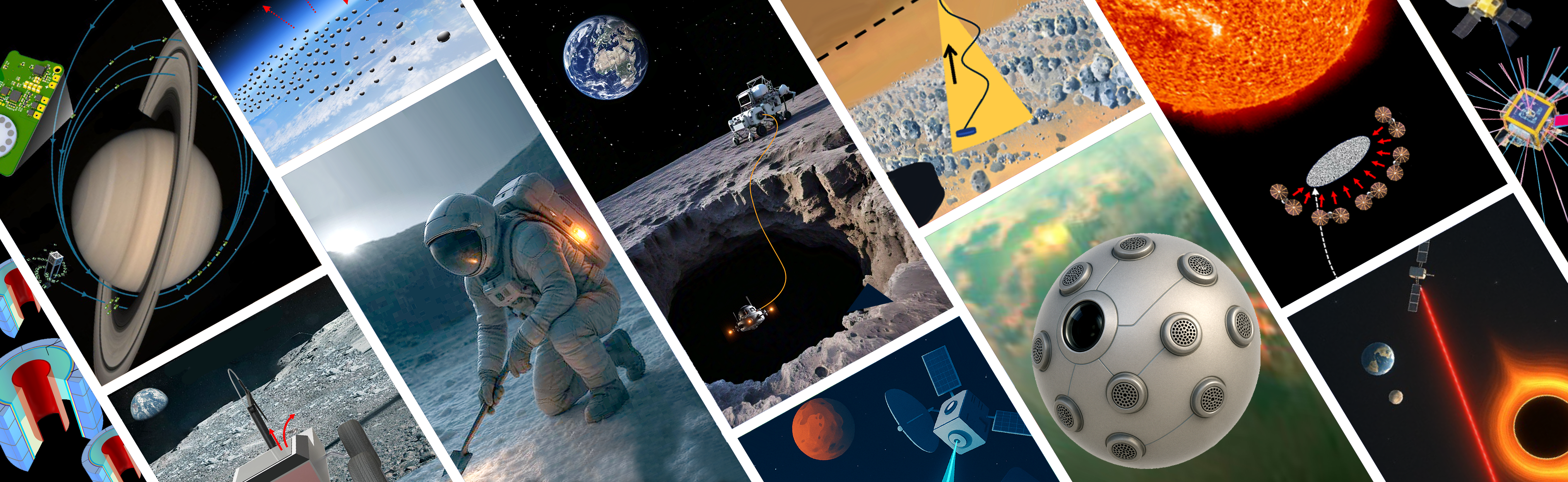
NASA's Innovative Advanced Concepts program has selected three ambitious Phase I projects for 2026 funding, each tackling fundamental challenges in space exploration and astronomy.
The first project, led by Saptarshi Bandyopadhyay at NASA's Jet Propulsion Laboratory, pursues "DimSun," a concept to reduce solar insolation using controllable dust clouds. This approach addresses thermal management for future missions to Venus and other hostile environments by creating artificial shade through engineered particle systems. Such technology could enable longer surface operations in extreme heat without requiring massive cooling infrastructure.
David Bugby, also at JPL, advances "CANVAS," a platform designed specifically for Venus exploration. The acronym captures the mission's core challenge: combining neomobility with on-Venus adaptability and survivability. Venus presents brutal conditions, with surface temperatures exceeding 460 degrees Celsius and atmospheric pressure 92 times Earth's. CANVAS seeks modular systems that can reconfigure for different scientific objectives while enduring this hostile environment, moving beyond traditional stationary landers.
Anish Damodaran at the University of Central Florida leads "PS21," a project transforming submillimeter space interferometry through photonic technologies. This work promises to revolutionize astronomical observation by replacing traditional radio dish arrays with optical systems. Photonic interferometry could enable more compact, lighter, and more flexible space-based observatories capable of detecting the earliest galaxies and characterizing exoplanet atmospheres with unprecedented precision.
NIAC, NASA's Innovative Advanced Concepts program, funds high-risk, high-reward research that typically takes 10 to 40 years to mature. Phase I projects receive approximately $175,000 to explore feasibility during nine-month studies. Successful concepts may advance to Phase II for deeper development and prototype work.
These 2026