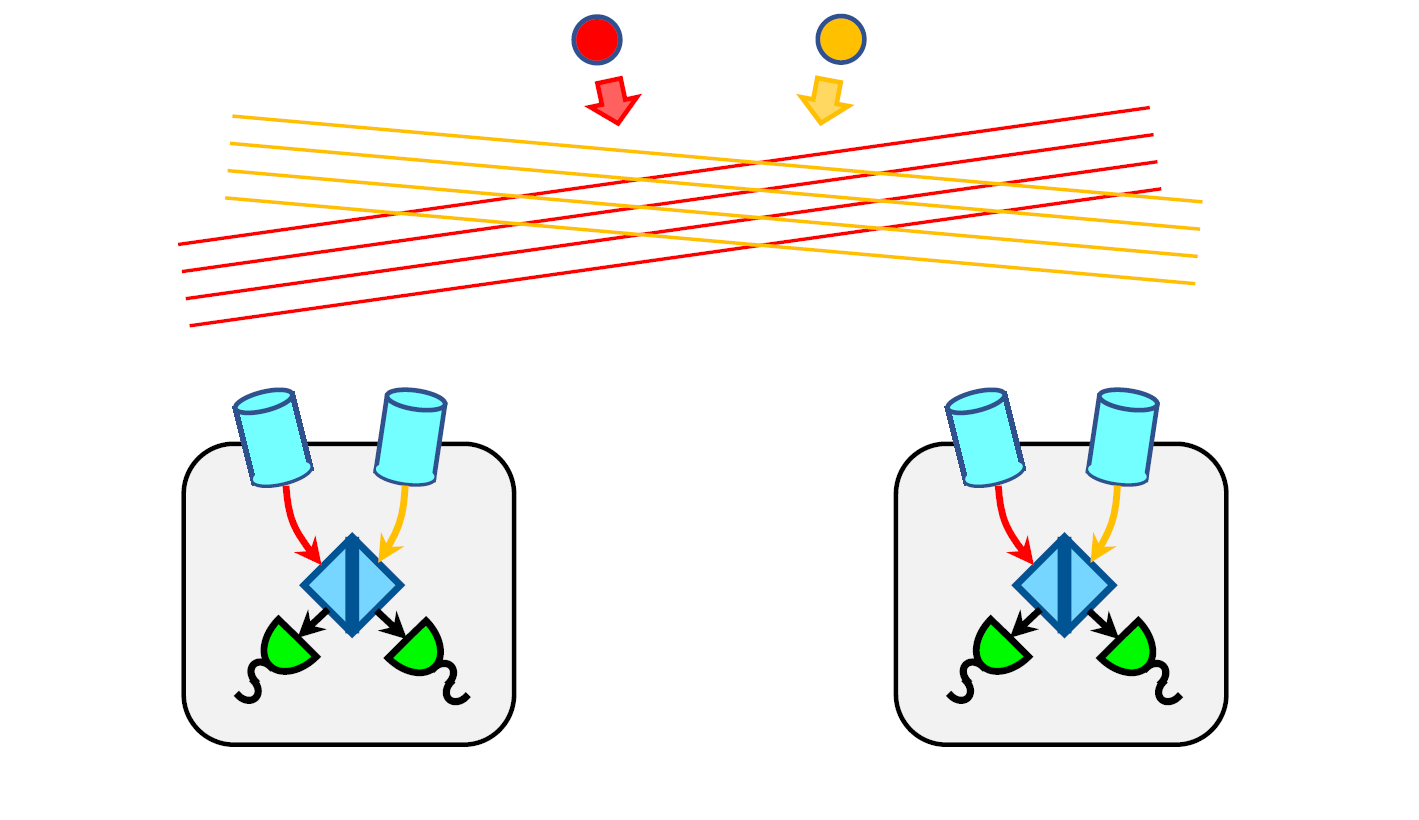
NASA-backed researchers at Brookhaven Science Associates are developing a novel gravitational wave detection method that exploits astrometric signatures—the tiny shifts in apparent star positions caused by passing gravitational waves.
The technique operates on a fundamental principle: when gravitational waves traverse Earth, they compress and stretch spacetime itself, creating coordinated movements across all objects in the sky. By measuring these minuscule positional changes with extraordinary precision, scientists can identify low-frequency gravitational waves that current ground-based detectors like LIGO and Virgo cannot resolve.
The innovation centers on using optically independent spacecraft to perform precision astrometry. Unlike terrestrial interferometers that measure laser light bouncing between mirrors, this space-based approach leverages the geometry of multiple satellites to detect gravitational wave signatures imprinted on stellar positions. The spacecraft's separation and independent optical systems eliminate cross-coupling effects that plague ground instruments, enabling sensitivity to lower-frequency signals.
Low-frequency gravitational waves carry distinct astrophysical sources: supermassive black hole mergers in distant galaxies, cosmic string vibrations from the early universe, and other massive phenomena beyond LIGO's detection band. Current pulsar timing arrays hint at these signals, but direct measurement remains elusive.
This approach complements existing gravitational wave observatories without competing for resources. LIGO and Virgo excel at detecting stellar-mass black hole collisions and neutron star mergers at higher frequencies. The astrometric method targets gravitational wave sources operating at fundamentally different scales and timescales, expanding humanity's observational window on the violent, energetic universe.
The precision required ranks among the most stringent in observational astronomy. Gravitational waves passing Earth induce stellar position shifts measured in microarcseconds. Achieving this demands exquisite control of spacecraft orientation, stellar cataloging accuracy, and optical measurement systems.