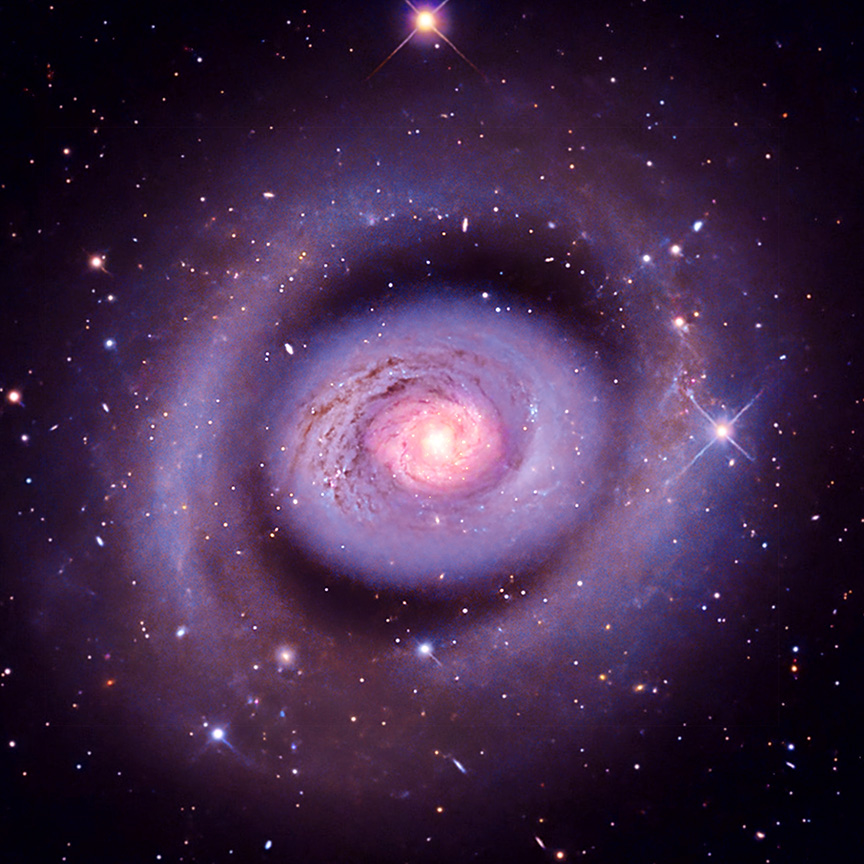
NASA's Chandra X-ray Observatory captured a new view of Messier 94, a spiral galaxy located 15 million light-years away in the constellation Hounds. The image, released June 30, 2026, reveals the galaxy's X-ray emissions with unprecedented clarity.
Messier 94, formally catalogued as NGC 4736, displays a distinctive architecture. A bright starburst ring encircles its core, where intense star formation occurs at rates far exceeding the galactic average. This inner ring appears to contain millions of young, massive stars burning through their fuel rapidly. The galaxy's unique oval-shaped internal structure channels gas inward, triggering the vigorous star birth around the nucleus.
Chandra detects high-energy X-rays emitted by hot gas and energetic phenomena within the galaxy. The starburst ring generates copious X-rays through supernovae, stellar winds, and accretion around black holes. These observations illuminate the mechanisms driving galactic evolution and chemical enrichment across cosmic time.
The Chandra data adds a critical layer to our understanding of Messier 94's behavior. While optical telescopes reveal the galaxy's visible structure and star populations, X-ray observations expose the violent, energetic processes reshaping its interior. Hot gas traced by Chandra traces shockwaves from stellar explosions, feedback from active star formation, and gravitational dynamics of the central black hole.
Messier 94 serves as a laboratory for studying starburst galaxies, objects undergoing intense bursts of star formation. Understanding these systems informs how galaxies build mass, recycle metals, and regulate their growth across billions of years. The starburst ring represents an extreme example of how galactic structure concentrates and amplifies star formation.
This observation demonstrates Chandra's continued scientific productivity. Launched in 1