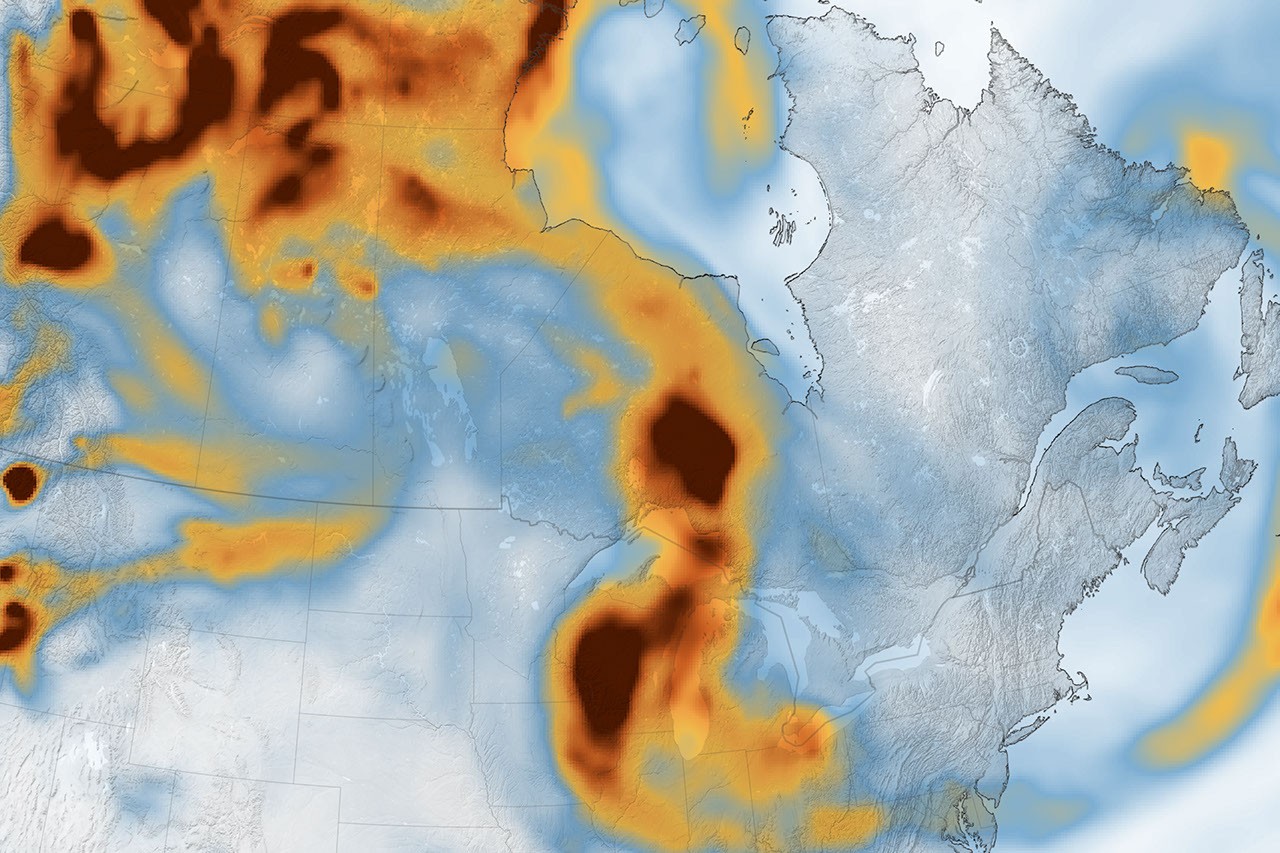
NASA satellite instruments tracked a plume of brown carbon across North America during July 2026, documenting how wildfire emissions degraded air quality over multiple U.S. and Canadian regions. Brown carbon, a light-absorbing aerosol produced by incomplete combustion in wildfires, poses distinct health risks compared to other particulate matter.
The agency deployed space-based sensors to monitor the pollutant's movement and concentration as it drifted eastward across the continent over seven days. This real-time tracking demonstrated how satellite technology captures the lifecycle of smoke plumes from their origin through atmospheric transport.
Brown carbon absorbs solar radiation more efficiently than standard soot particles, warming the atmosphere locally while reducing surface temperatures below the plume. This dual heating effect influences regional weather patterns and climate dynamics. The July 2026 event affected air quality indices across populated areas, prompting health advisories and visibility warnings from environmental agencies.
NASA's Earth-observing satellites, including instruments aboard the Aqua and Terra missions, collected aerosol optical depth measurements and spectral data distinguishing brown carbon from other atmospheric particulates. These observations feed into air quality forecasting models used by the Environmental Protection Agency and Environment and Climate Change Canada.
Wildfire smoke transport across North America occurs annually but varies in intensity and geographic reach. The July 2026 episode underscores how continental-scale atmospheric circulation carries smoke thousands of kilometers from fire sources, exposing populations far from active burn zones. Understanding brown carbon's optical properties and atmospheric behavior informs public health responses and long-term climate assessments.
Continued satellite monitoring of wildfire emissions provides critical data for assessing how changing fire regimes, driven by shifting climate patterns, alter air quality and radiative forcing across the hemisphere. These measurements establish baselines for evaluating future smoke transport events and their cumulative atmospheric effects.