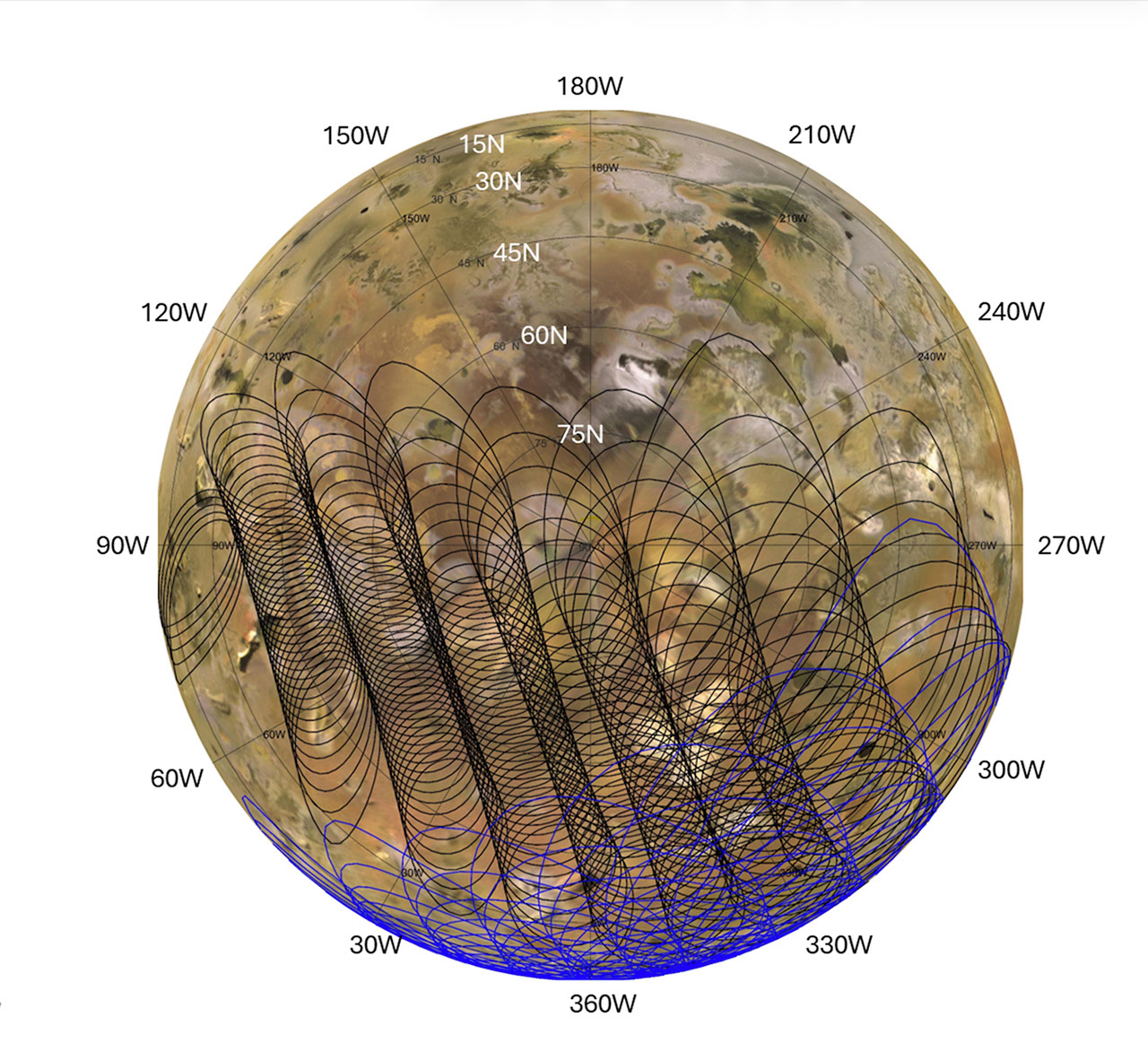
NASA's Juno spacecraft has used its Microwave Radiometer to map thermal emissions from Jupiter's volcanic moon Io during two close flybys in late 2023. The instrument captured data from Perijove 57 on December 30, 2023, and Perijove 58, with the sensor's footprints covering portions of Io's northern and southern hemispheres.
The Microwave Radiometer penetrates beneath Io's surface to detect heat signatures that visible-light cameras cannot capture. This capability reveals subsurface thermal activity hidden under the moon's radiation-scoured crust. Io ranks as the most volcanically active body in the solar system, with hundreds of active volcanic vents driven by tidal heating from Jupiter's gravitational pull.
Juno's data maps where molten material lies beneath Io's exterior. The spacecraft's proximity during these flybys generated high-resolution microwave observations that complement decades of remote sensing from distant platforms. Unlike infrared instruments, which measure only surface temperatures, the Microwave Radiometer's longer wavelengths penetrate several centimeters into Io's geology, exposing the internal heat distribution that drives volcanic eruptions.
These observations refine understanding of how tidal friction generates and sustains Io's extreme volcanism. Jupiter's gravity continuously kneads Io's interior, causing internal friction that melts rock. By mapping subsurface heat patterns, Juno reveals where magma chambers accumulate and how thermal energy distributes across the moon.
The data contributes to broader questions about volcanic worlds throughout the galaxy. Io serves as a natural laboratory for studying extreme geological processes. As astronomers search for habitable exoplanets, they investigate how tidal heating shapes planetary interiors. Io demonstrates the violent energy transfers possible when a moon orbits a gas giant at close range