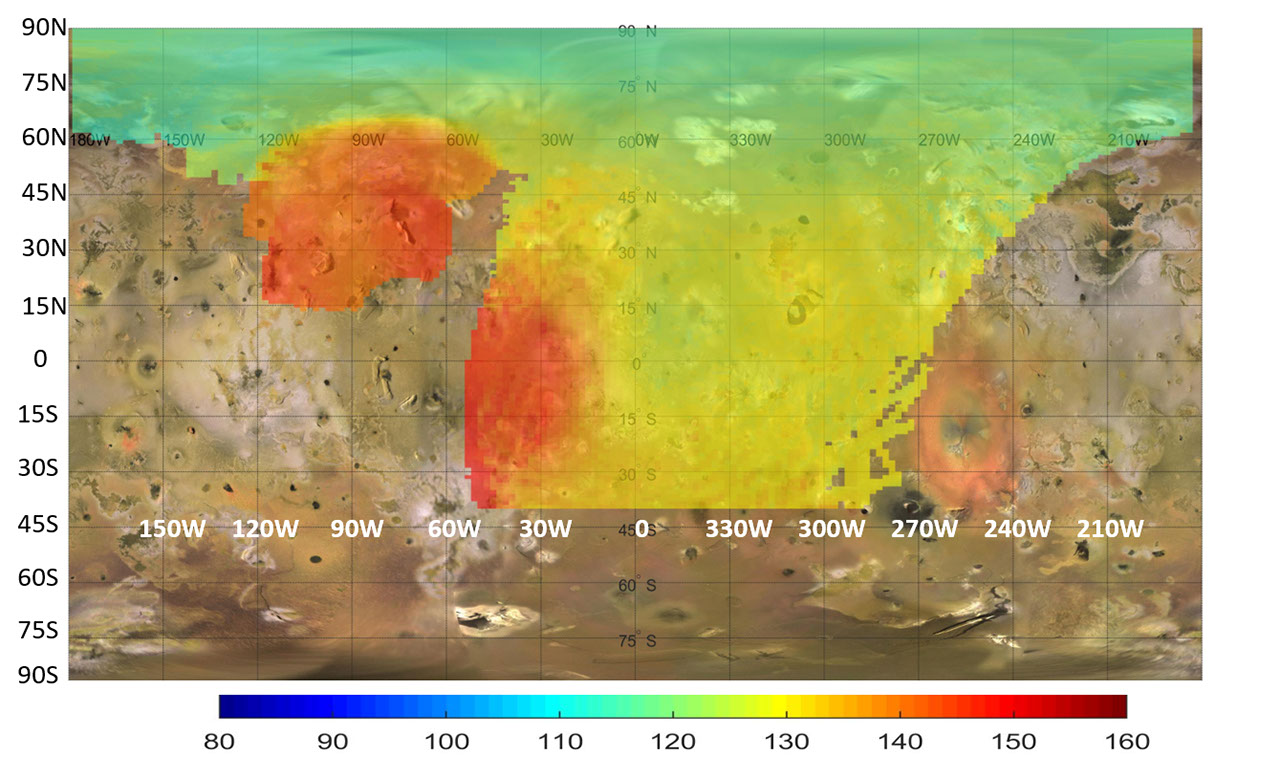
NASA's Juno spacecraft has penetrated beneath the surface of Jupiter's moon Io using its Microwave Radiometer (MWR) instrument, revealing heat signatures rising from subsurface layers. The MWR's lowest frequency channels, operating at 0.6 and 1.25 gigahertz, can penetrate approximately 6 kilometers into Io's crust, revealing thermal information that infrared instruments cannot access.
This capability represents a fundamental shift in how scientists study Io's extreme geology. While traditional infrared sensors measure only surface temperatures, the microwave data exposes the heat distribution beneath active volcanic regions. Io hosts the solar system's most intense volcanic activity, with hundreds of active volcanoes and surface temperatures exceeding 1,500 Kelvin in eruption zones.
The Microwave Radiometer was designed to study Jupiter's atmosphere and radiation belts, but its penetrating wavelengths proved invaluable for studying Jupiter's moons. The instrument's ability to measure subsurface heat provides direct constraints on Io's internal thermal structure and the mechanics driving its volcanism. This volcanism stems from tidal heating caused by Jupiter's gravity as Io orbits alongside the moon Europa.
Juno entered Jupiter orbit in 2016 and has conducted multiple close flybys of Io since 2023, gathering the most detailed observations of the moon in over two decades. Each pass brings the spacecraft within thousands of kilometers of Io's turbulent surface. The new microwave maps reveal heat distribution patterns that correlate with known volcanic hotspots but also expose subsurface thermal anomalies that ground-based telescopes cannot detect.
Understanding Io's internal heat engine provides crucial insights into tidal heating across the solar system. The mechanisms driving Io's volcanism apply directly to understanding potentially habitable ocean worlds like Europa and Ence