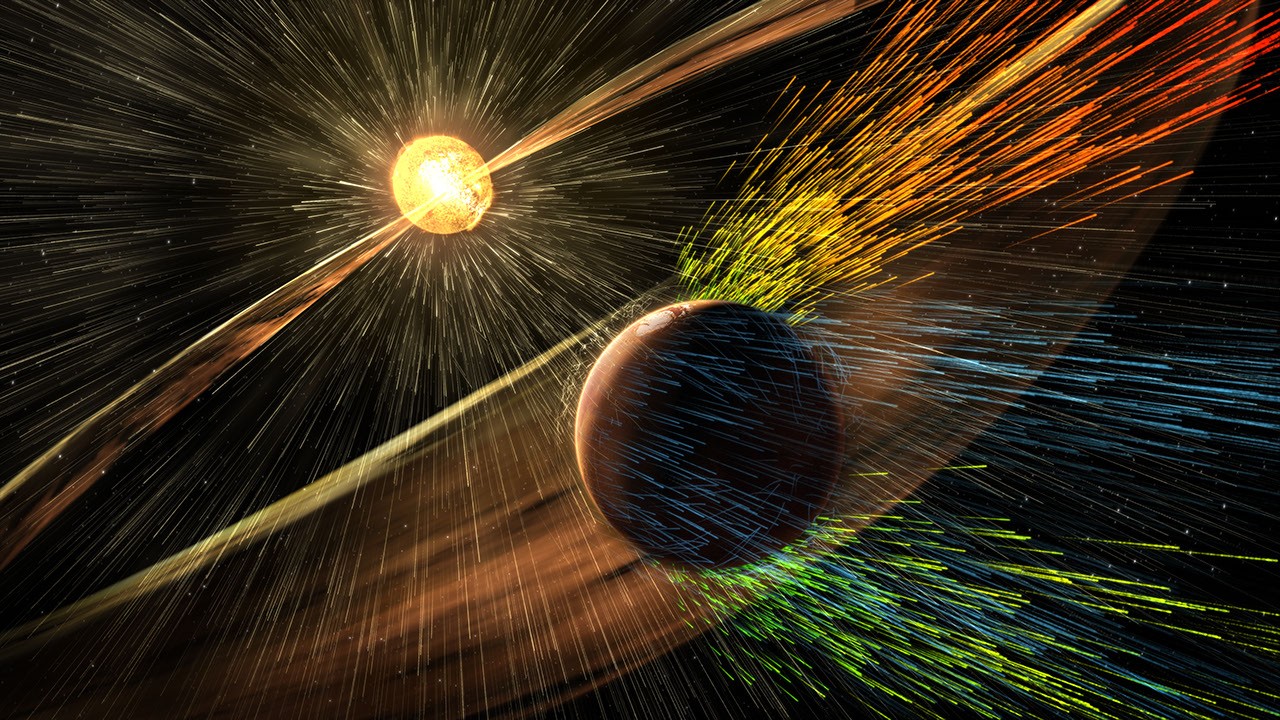
NASA's MAVEN spacecraft has revealed that Martian auroras form through the same particle acceleration mechanism responsible for Earth's auroras, according to research published in Nature Communications. The Mars Atmosphere and Volatile Evolution mission detected how charged particles spiral into Mars' atmosphere along magnetic field lines, mirroring the process that generates Earth's polar lights.
Earth's auroras occur when solar wind particles collide with atmospheric gases, creating the characteristic green and red glows. MAVEN observations show Mars experiences this identical phenomenon, despite lacking a global magnetic field like Earth's. Instead, Mars hosts localized magnetic anomalies concentrated in the southern hemisphere, remnants from when the planet possessed a planetary magnetosphere billions of years ago.
The discovery reshapes understanding of Martian atmospheric dynamics. These auroras represent direct evidence of how the solar wind interacts with Mars' thin atmosphere, stripping it away over time. This process contributed to Mars' transformation from a potentially habitable world with a thicker atmosphere to the cold, dry planet observed today.
MAVEN's instruments, particularly its Suprathermal and Thermal Ion Composition spectrometer, tracked particle energies and trajectories with unprecedented precision. The spacecraft detected electrons and ions accelerated along magnetic field lines, creating localized bright spots in the Martian sky above magnetic anomalies.
This research carries implications for future human missions to Mars. Understanding how the solar wind batters the Martian atmosphere helps scientists predict radiation exposure and plan for protective measures. The study also provides context for ongoing investigations into Mars' habitability history, demonstrating active atmospheric loss mechanisms that operated throughout the planet's evolution.
MAVEN, launched in 2013, continues expanding knowledge of planetary atmospheres and space weather effects. The mission's findings establish Mars as a natural laboratory for studying solar wind particle dynamics across multiple planetary environments.