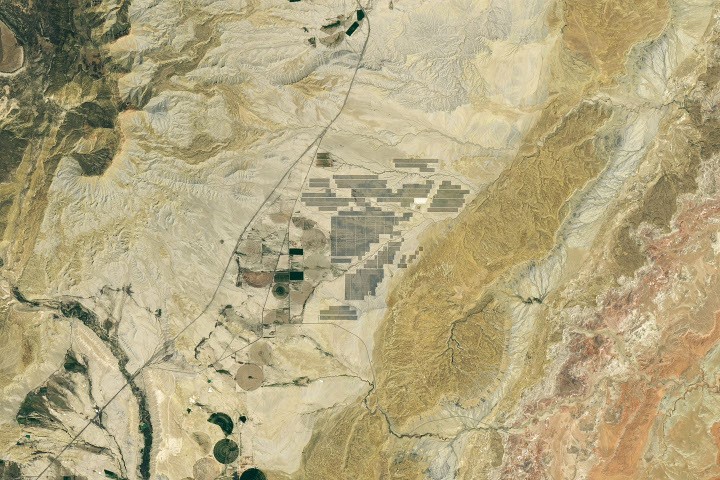
# A Million-Panel Project
Utah has completed one of the region's largest solar installations, deploying over one million photovoltaic panels paired with battery storage capacity. The facility represents a substantial shift toward renewable energy infrastructure in the American West, where solar resources remain abundant and largely underutilized compared to fossil fuel generation.
The project combines distributed solar arrays with grid-scale battery storage, addressing a fundamental challenge in renewable energy adoption. Solar generation peaks during daylight hours, creating a mismatch with evening demand. Battery systems capture excess power during peak production and release it when the sun sets, smoothing the power supply curve and reducing reliance on fossil fuel peaking plants.
NASA's involvement reflects the agency's broader mission to monitor energy infrastructure and climate impacts from space. Satellite data from NASA Earth observation programs tracks utility-scale solar deployment across the country, providing metrics on the nation's transition toward decarbonization. These measurements help utilities, planners, and policymakers understand installation trends and grid modernization progress.
The Utah facility joins similar megawatt-scale solar projects emerging across the region, including installations in Nevada, Arizona, and California. Each project reduces carbon emissions while generating revenue through power sales to regional grids. Battery storage costs have dropped more than 80 percent over the past decade, making paired solar-plus-storage increasingly economical compared to traditional power plants.
Utah's renewable energy sector has expanded rapidly despite the state's historical reliance on fossil fuels. Utility companies and independent power producers now bid competitively for contracts to supply solar energy to customers across multiple states. The economics have fundamentally shifted. New solar plus storage often undercuts the operating costs of aging coal and natural gas plants.
This Utah installation demonstrates how utility-scale renewable energy infrastructure operates in the modern grid. The facility will generate electricity for thousands of households while reducing atmospheric carbon dioxide emissions equivalent to taking thousands of vehicles off the road