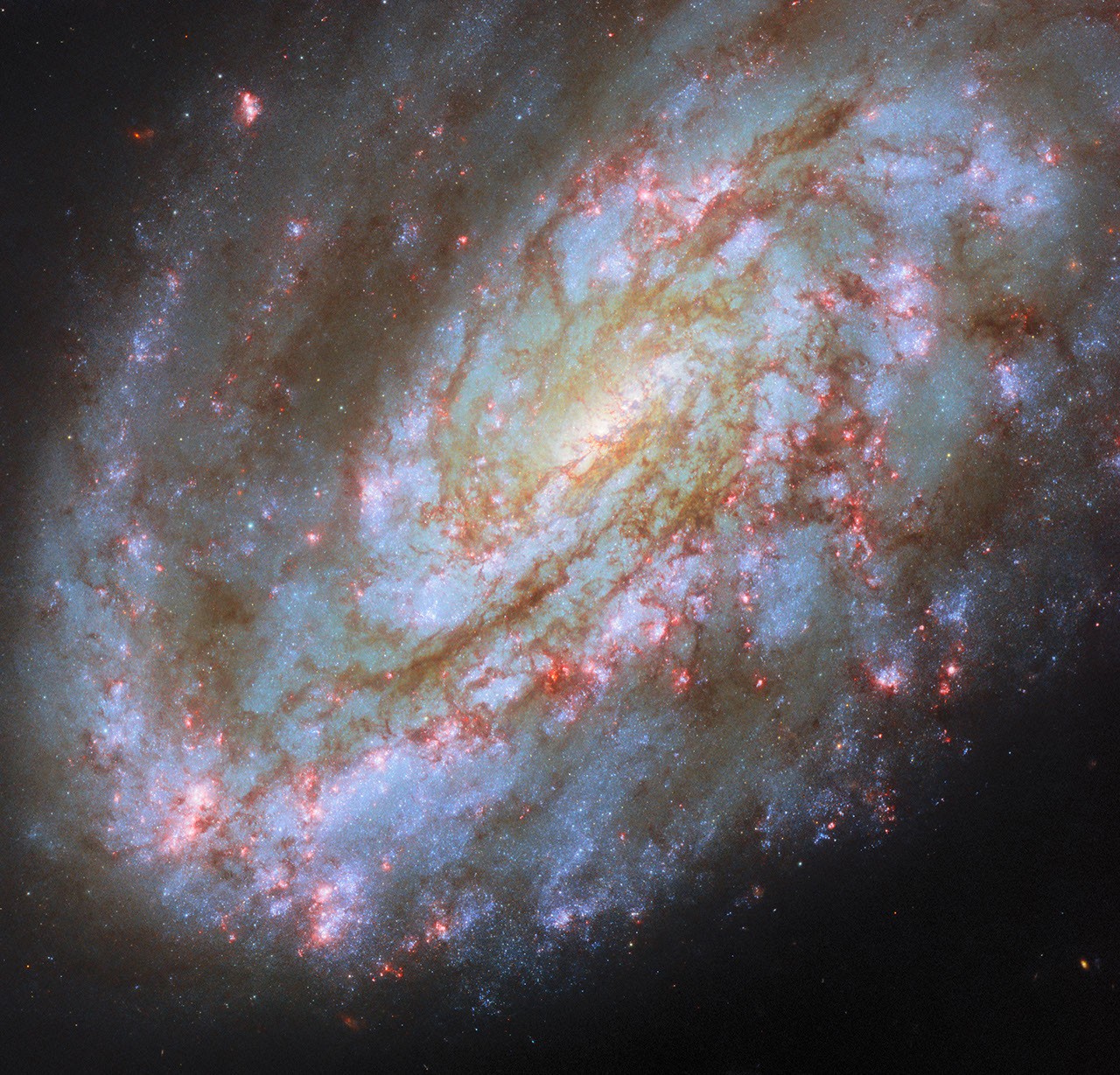
The Hubble Space Telescope has captured striking imagery of NGC 4654, a spiral galaxy 72 million light-years distant in Virgo. The observations reveal an asymmetrical structure that challenges conventional models of galactic architecture.
NGC 4654 displays a lopsided spiral pattern, with one side noticeably more pronounced than the other. This asymmetry results from gravitational interactions with nearby galaxies within the Virgo Cluster. The warping and distortion of the disk suggest ongoing tidal forces reshaping the galaxy's structure.
Hubble's Advanced Camera for Imaging resolves stars and dust lanes across NGC 4654, allowing astronomers to map the distribution of stellar populations and interstellar material. The observations help constrain models of how galaxies evolve through gravitational encounters. Such interactions are common in dense galactic clusters where multiple systems orbit within close proximity.
The galaxy's offset spiral arms and trailing dust indicate that a gravitational encounter occurred relatively recently in cosmic terms, perhaps within the last billion years. These perturbations trigger bursts of star formation along the disturbed regions while simultaneously stripping gas from the outer regions through tidal effects.
Studying galaxies like NGC 4654 provides context for understanding our own Milky Way's history. The Local Group contains Andromeda and the Triangulum Galaxy, which may have influenced the Milky Way through past encounters. By examining systems in various stages of interaction, astronomers reconstruct the merger history of galaxies across cosmic time.
The Virgo Cluster itself, containing over 1,300 galaxies, represents a natural laboratory for studying gravitational dynamics. Hubble observations of cluster members continue revealing how environmental factors shape galactic morphology, gas content, and star formation rates. These data feed into computational models that simulate billions of years of galactic evolution, helping explain the diversity of