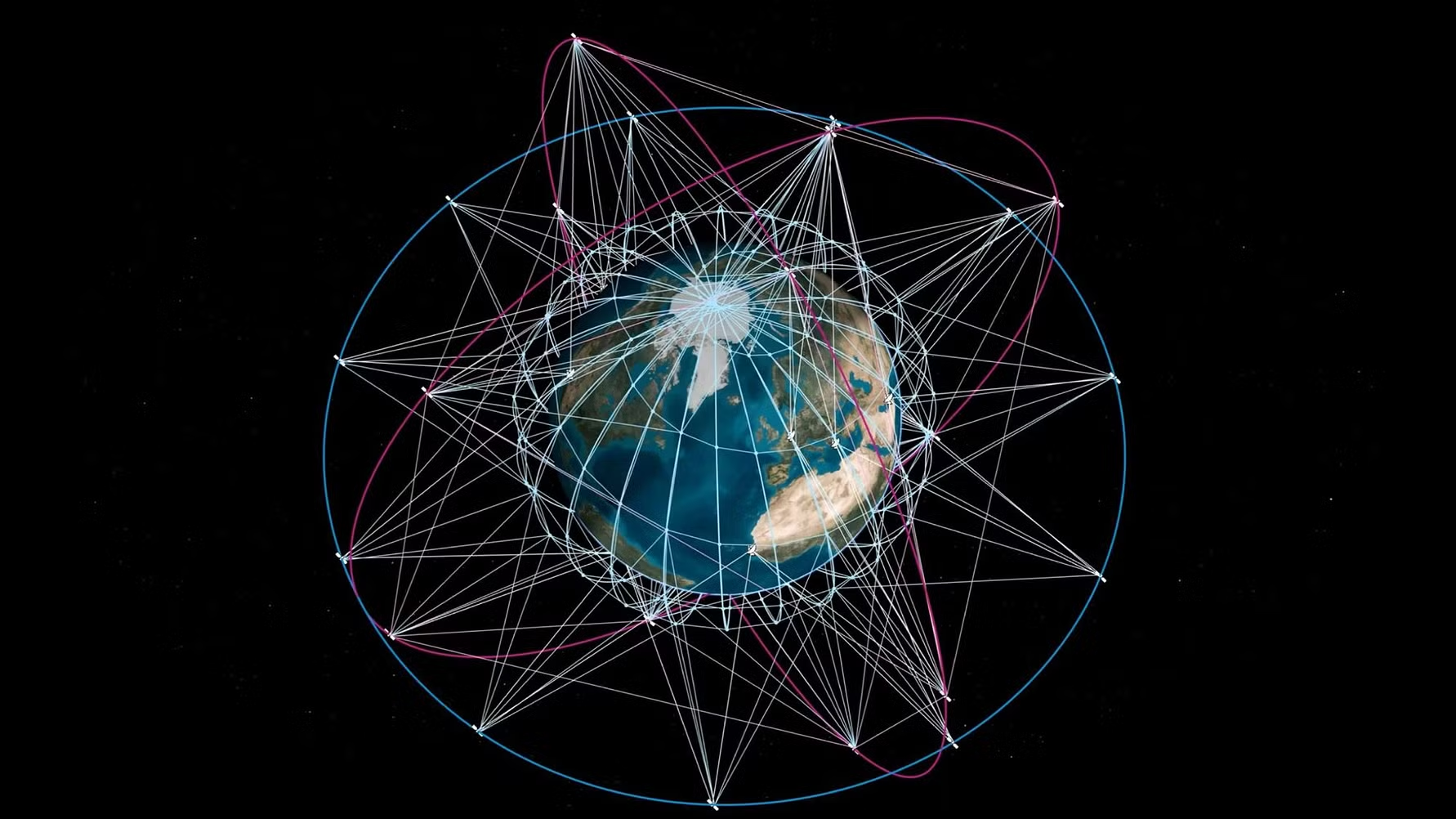
Poland has committed 745 million dollars to the European Union's IRIS² satellite constellation program, marking a major financial pledge toward Europe's independent space infrastructure. The investment demonstrates Poland's strategic commitment to reducing continental reliance on non-European satellite systems for communications and Earth observation.
IRIS² represents the EU's response to competing global mega-constellations. The program aims to deploy a multi-orbit constellation combining low Earth orbit and medium Earth orbit satellites to provide secure, resilient connectivity across Europe and its territories. Unlike SpaceX's Starlink or Amazon's Project Kuiper, IRIS² operates under EU sovereignty and control, ensuring data security and operational independence during geopolitical tensions.
Poland's contribution places it among the EU's leading financial supporters of the initiative. The funding supports manufacturing, launch operations, and ground infrastructure development. European aerospace companies including Airbus, Thales Alenia Space, and other contractors will execute the constellation's construction and deployment. The program targets initial operational capability within the coming years, with full constellation deployment following thereafter.
The investment reflects broader European strategic thinking. Space-based communications now underpin critical infrastructure, emergency response systems, and defense operations. The IRIS² constellation provides the EU direct access to satellite internet without depending on private American operators, particularly valuable during crises where commercial systems might face supply disruptions or geopolitical complications.
Poland's participation strengthens Central European involvement in EU space capabilities. The nation previously hosted significant satellite operations and maintains growing aerospace manufacturing sectors. This commitment positions Polish industry for contracts related to constellation production and ground station deployment.
IRIS² funding has grown incrementally as member states recognize its strategic value. The program operates under the EU Space Programme framework, coordinated by the European Commission and European Space Agency. Poland joins Germany, France, Italy, and Spain as substantial financial contributors to this cornerstone of European space autonomy.