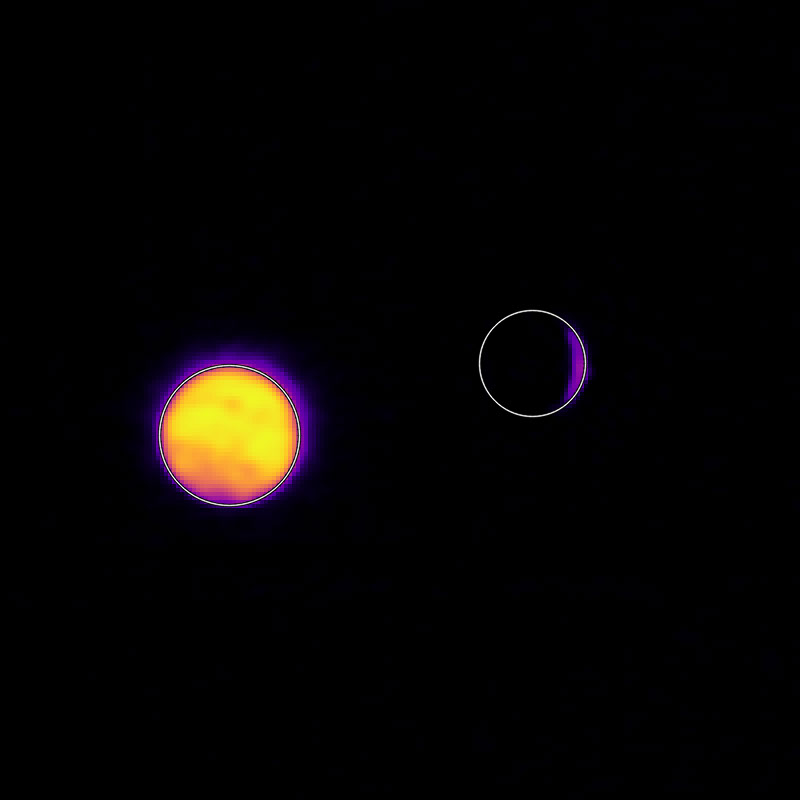
NASA's ESCAPADE mission has captured the first images of Earth and Moon together during its journey to Mars. On July 3, one of the two ESCAPADE spacecraft photographed both bodies in visible and thermal infrared wavelengths from a distance of 363,250 miles from Earth and 115,600 miles from the Moon.
ESCAPADE consists of two identical spacecraft designed to study Mars's upper atmosphere and how solar wind strips away the planet's ionosphere. The mission launches later this year. These images represent an engineering milestone, confirming the spacecraft's imaging systems function properly during their long transit to the red planet.
The thermal infrared observations prove particularly valuable. They capture Earth's heat signature and atmospheric dynamics in ways visible light alone cannot. The Moon's thermal characteristics provide a cold reference point for calibrating the instruments. Both features matter for ESCAPADE's primary science objective: measuring how stellar winds interact with Mars's thin atmosphere.
This family portrait demonstrates the spacecraft's ability to collect data across multiple spectral bands simultaneously. The dual-spacecraft design lets ESCAPADE perform three-dimensional measurements of plasma dynamics around Mars, filling critical gaps in our understanding of atmospheric escape. Mars lost most of its atmosphere billions of years ago, leaving a surface too thin to support liquid water. Understanding this loss process helps scientists predict atmospheric evolution on exoplanets and informs human exploration strategies for Mars.
The ESCAPADE spacecraft continue accelerating toward Mars after their July launch. Their arrival in late 2026 will place them in complementary orbits, allowing simultaneous measurements at different altitudes and times. NASA's commitment to studying planetary atmospheres through multiple simultaneous vantage points has transformed our knowledge of space weather effects throughout the solar system.