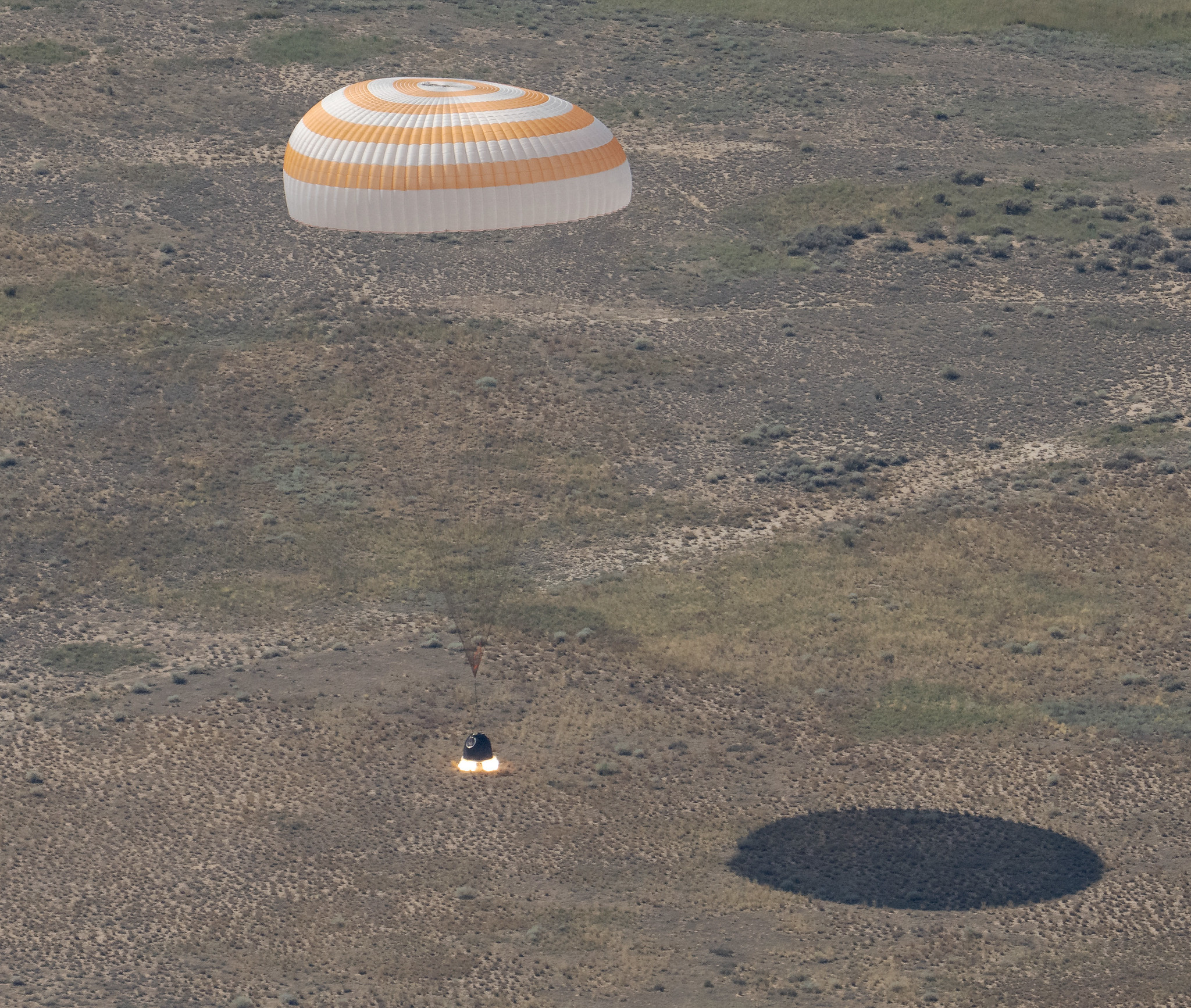
NASA astronaut Chris Williams and two Roscosmos cosmonauts, Sergey Kud-Sverchkov and Sergei Mikaev, returned to Earth on Sunday after eight months aboard the International Space Station. Their Soyuz capsule executed a parachute-assisted landing at 5:27 a.m. CDT near Dzhezkazgan, Kazakhstan, following an undocking from the station at 2:03 a.m.
The crew completed an extended research mission focused on microgravity experiments that advance both human physiology studies and material science. Work in the station's laboratories included investigations into how prolonged weightlessness affects bone density, muscle atrophy, and fluid shifts in the human body. These findings directly inform NASA's plans for deep space exploration, including sustained lunar operations and eventual Mars missions where astronauts will face similar physiological challenges.
Williams, a Navy pilot selected as an astronaut in 2017, logged over 240 days in space across this mission. His return marks another successful rotation of ISS crews, part of NASA's continuous human presence in low Earth orbit for over two decades. The International Space Station operates through partnership between NASA, Roscosmos, ESA, JAXA, and CSA, maintaining crews of six to seven astronauts and cosmonauts conducting research that benefits scientific understanding on Earth.
The Soyuz spacecraft remains the primary crew transport vehicle to the station, with Russia providing reliable launch and return capabilities. Though commercial crew vehicles from SpaceX and Boeing operate alongside traditional Soyuz missions, the Soyuz system continues proving essential for ISS operations. Recovery teams retrieved the capsule and its occupants from the steppes of Kazakhstan, a landing zone used for decades.
Williams and his crewmates' research contributions span protein crystal growth, combustion dynamics, and