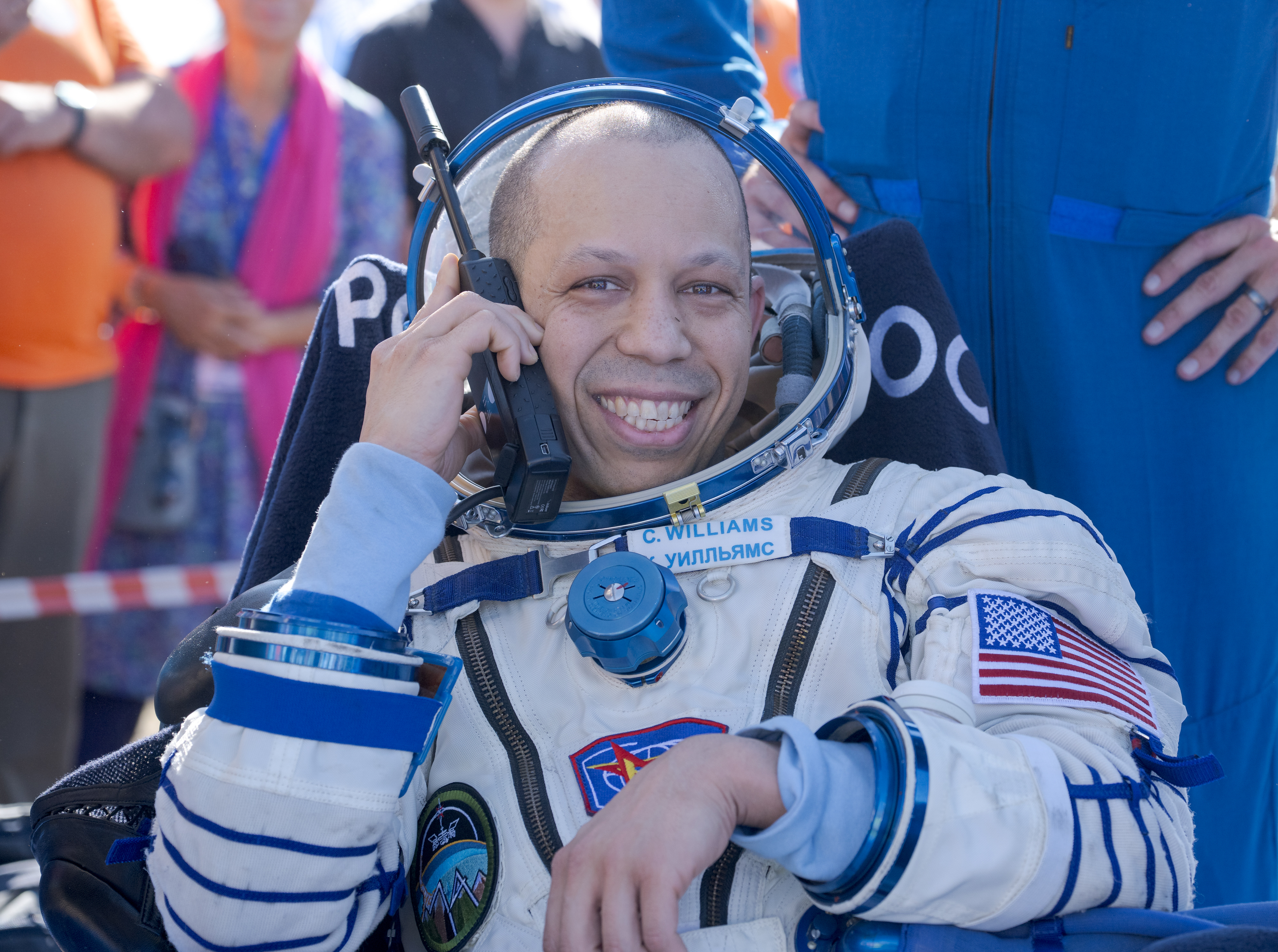
NASA astronaut Chris Williams returned to Earth on July 26, 2026, landing in Kazakhstan alongside Roscosmos cosmonauts Sergey Kud-Sverchkov and Sergei Mikaev. The touchdown marked the completion of Williams' first spaceflight and an eight-month deployment aboard the International Space Station.
During his tenure on the orbital laboratory, Williams served as a crew member for Expedition 74. He conducted scientific investigations across multiple disciplines and participated in technology demonstrations designed to advance capabilities for future exploration missions. The work he performed contributed to the continuous research programs that define the ISS partnership between NASA, Roscosmos, and other international space agencies.
Williams' mission exemplifies the operational cadence of ISS crew rotations, which typically occur every six months to maintain continuous human presence in low Earth orbit. His eight-month stay extended slightly beyond the standard rotation, reflecting scheduling adjustments across the partner agencies. The successful return of all three crew members in good condition demonstrates the reliability of Soyuz spacecraft operations, which have remained the primary vehicle for transporting astronauts and cosmonauts to and from the station since the retirement of the Space Shuttle program in 2011.
The ISS continues to serve as humanity's only permanently inhabited orbital outpost, conducting experiments in microgravity that are impossible to replicate on Earth. Research aboard the station spans materials science, biology, Earth observation, and technology validation for deep-space missions. Williams' contributions to these efforts support both near-term scientific objectives and longer-term goals including preparations for lunar return missions and eventual Mars exploration.
The partnership between NASA and Roscosmos on ISS operations persists despite geopolitical tensions, underscoring the collaborative framework that has sustained the program since its inception in 1998. Crew exchanges and joint research continue uninterrupted, maintaining a tradition of space