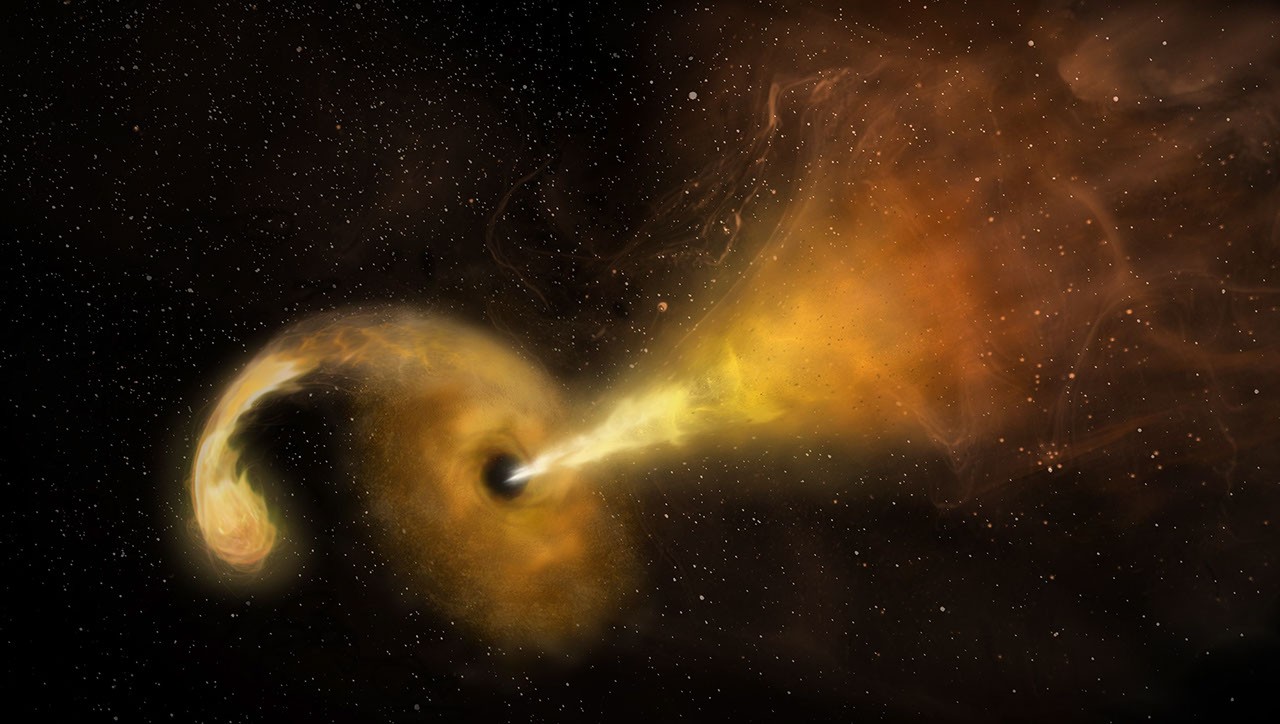
NASA's Neil Gehrels Swift Observatory detected a supermassive black hole devouring a star at an unprecedented distance from its host galaxy's center. The discovery challenges assumptions about where wandering black holes reside and how they behave when isolated from galactic nuclei.
The event, captured through the gravitational disruption of a star, represents the first confirmed tidal disruption event triggered by an "orphan" black hole far from a galaxy's core. When the star ventured too close, the black hole's immense gravity tore the stellar material apart, heating it to extreme temperatures and generating intense X-ray emissions that Swift detected.
Tidal disruption events themselves rank among astronomy's rarest phenomena. Stars wander into the destructive zones of black holes perhaps once every ten thousand years for a typical galaxy. Finding such an event caused by a displaced supermassive black hole—a black hole ejected from its original galactic center through gravitational interactions—expands the scope of where astronomers must search for these objects.
Supermassive black holes typically anchor galactic centers, containing millions to billions of solar masses. However, cosmic collisions and mergers can knock these giants loose, sending them wandering through space. Such displaced black holes become invisible when dormant, making direct observation nearly impossible. A tidal disruption event transforms an orphan black hole into a temporary beacon, briefly revealing its location and properties through the violent consumption of stellar material.
Swift's discovery suggests that wandering supermassive black holes inhabit the outer regions of galaxies more commonly than previous models predicted. This finding opens new channels for detecting these elusive objects and understanding the dynamics of galactic centers.
The observatory's rapid response capabilities proved essential. Swift can pivot quickly to follow transient events and coordinate observations across multiple wavelengths, from ultraviolet through X-ray frequencies. This flexibility allowed scientists to