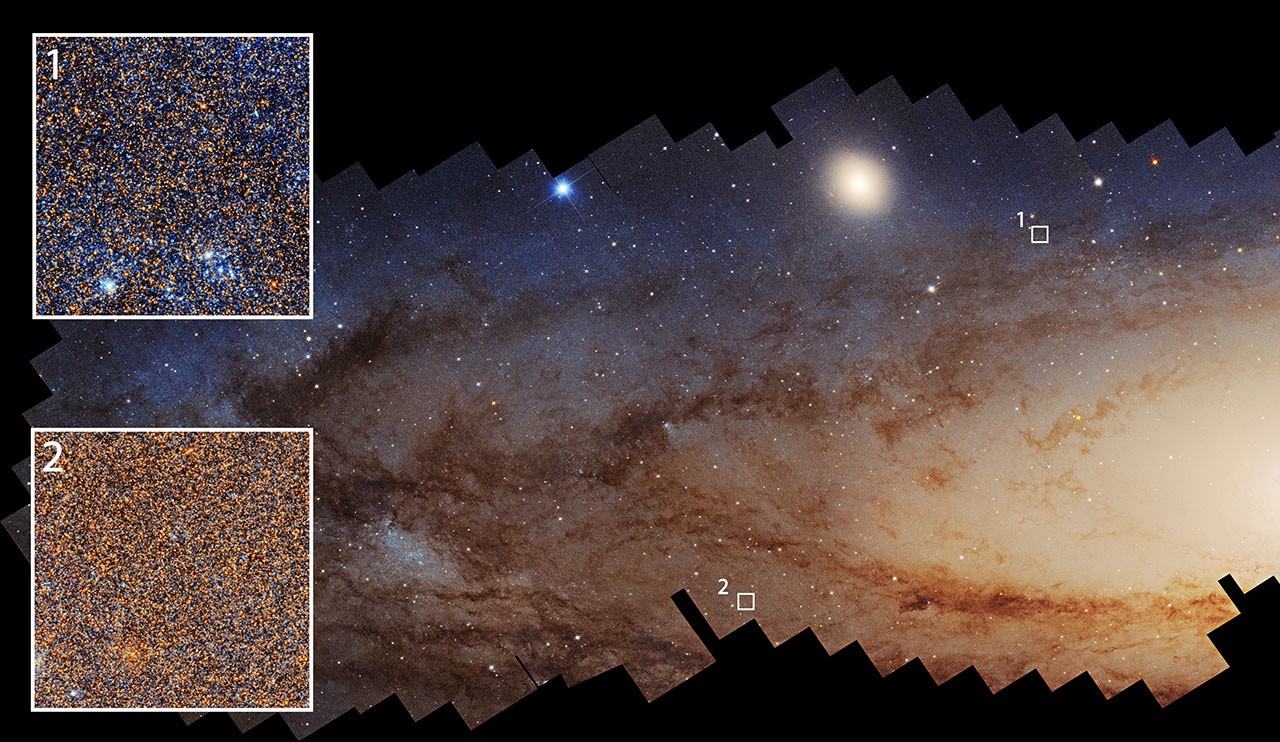
NASA's Hubble Space Telescope has detected a dramatic shift in the Andromeda galaxy. Star formation there has declined substantially over the past 500 million years, marking a turning point in the cosmic neighbor's evolution.
Hubble observations reveal that Andromeda, located 2.5 million light-years from Earth, produces far fewer new stars than it did half a billion years ago. This slowdown represents a major phase transition for the galaxy, which once churned out stars at a much higher rate.
The finding emerges from Hubble's detailed imaging of stellar populations across Andromeda's disk. By analyzing the ages and masses of stars, astronomers mapped the history of star formation with unprecedented precision. The data shows a consistent downward trend in the rate at which gas converts into new stars over recent cosmic time.
Several factors likely drive this decline. Andromeda's supply of cold hydrogen gas, the raw fuel for star birth, has diminished substantially. Galactic winds may have swept away remaining reserves of star-forming material. Additionally, the galaxy's interaction with the Milky Way system has accelerated this process through tidal forces that disrupt gravitational dynamics.
This trajectory matters for understanding galactic aging. Spiral galaxies like Andromeda and the Milky Way enter a quiescent phase when their star formation engines sputter. Eventually, Andromeda will collide with the Milky Way in roughly 4.5 billion years, triggering a final burst of stellar creation before settling into a quiet, aging elliptical galaxy.
Hubble's observations provide Earth's most detailed view of how galaxies mature. They reveal that cosmic maturation follows predictable patterns. Andromeda shows us what happens when a galaxy exhausts its fuel supply and transforms from a prolific star-factory into a more serene system where the light