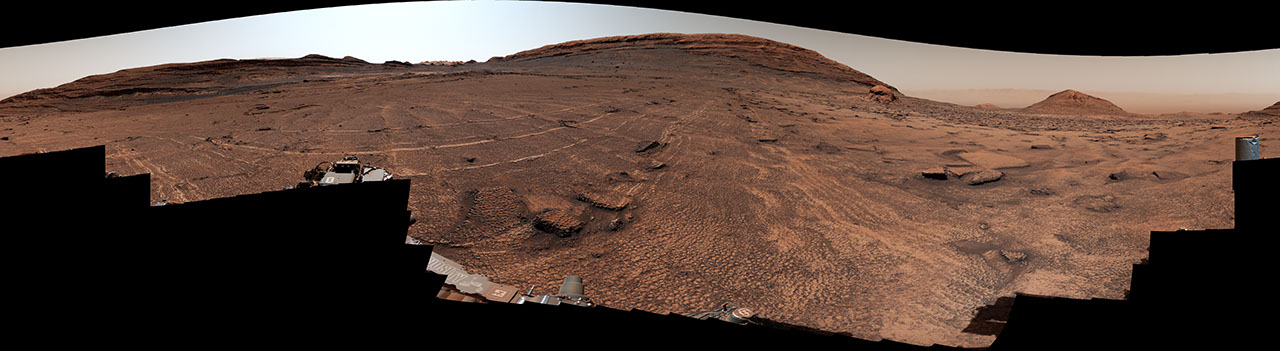
NASA's Curiosity rover has documented an expansive field of polygons on Mars, a discovery that reveals new clues about the Red Planet's geological history and past climate conditions.
The rover captured this 360-degree panorama on sols 4,930 and 4,931 of its mission, in June 2026. While Curiosity has encountered polygonal surface features before during its thirteen-year traverse, never has the rover observed such a dense concentration in a single location.
Polygons on Mars form through specific geological processes tied to freeze-thaw cycles and desiccation. When water-rich soil freezes and thaws repeatedly, or when wet mud dries and contracts, the surface fractures into these geometric patterns. The sheer abundance of polygons in this field suggests sustained periods of liquid water and seasonal temperature fluctuations in Mars' past, conditions radically different from the cold, arid planet we observe today.
The discovery carries direct implications for understanding Mars' climate evolution. The presence of such extensive polygon fields indicates that ancient Mars experienced hydrological activity on a scale sufficient to leave visible geological imprints across wide areas. This reinforces evidence that Mars once possessed a thicker atmosphere and warmer surface capable of supporting liquid water cycles.
Curiosity's instruments have continuously documented the transition from a potentially habitable Mars to its current state. Located in Gale Crater, the rover has been analyzing rock layers and atmospheric composition to reconstruct planetary change. This polygon field adds another layer to that narrative, showing that water-driven weathering and climate variability shaped vast regions of the Martian surface.
The rover's robotic arm instruments, including spectrometers and imaging systems, will analyze samples collected from the polygon field. These measurements help scientists determine the mineralogy and chemical composition of the soil, providing further context for when these features formed and what conditions prevailed during their