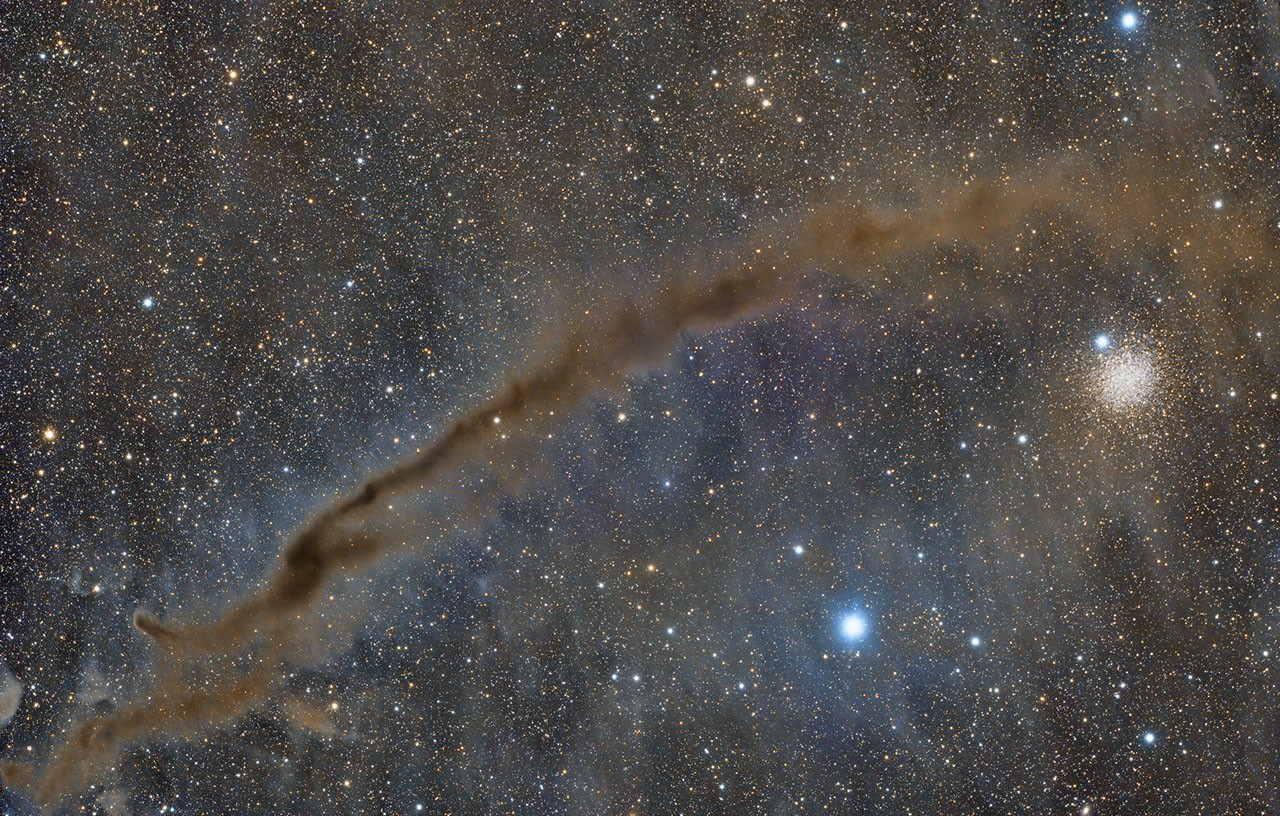
NGC 4372, a globular cluster nestled in the southern sky, shares the frame with a striking dark nebula known informally as the Dark Doodad. This pairing offers astronomers a textbook example of how stellar populations and interstellar dust structures coexist within our galaxy.
The globular cluster NGC 4372 contains hundreds of thousands of stars bound together by gravity, orbiting the Milky Way's halo. Located roughly 19,000 light-years away, it ranks among the larger globular clusters visible from Earth. The cluster's densely packed core creates a brilliant concentration of ancient stars, predominantly Population II objects billions of years old.
The Dark Doodad, a dark nebula stretching across the background, represents regions where dust and gas block light from distant stars. These structures form where star-forming material has not yet ignited into stellar fusion. The contrast between the glowing cluster and the obscuring dust creates compelling visual geometry that reveals the three-dimensional architecture of our galactic neighborhood.
Observations of such fields yield data on stellar ages, chemical composition, and the distribution of interstellar matter. The ancient stars in NGC 4372 contain fewer heavy elements than younger Population I stars, offering clues about chemical enrichment throughout galactic history. The dark nebula nearby demonstrates active star-formation regions where gravity continues collapsing gas clouds into new suns.
This pairing exemplifies why ground-based and space-based observatories continue studying globular clusters and their surrounding environments. Each observation refines our understanding of galactic structure, stellar evolution, and the physics governing star birth and death across cosmic time.