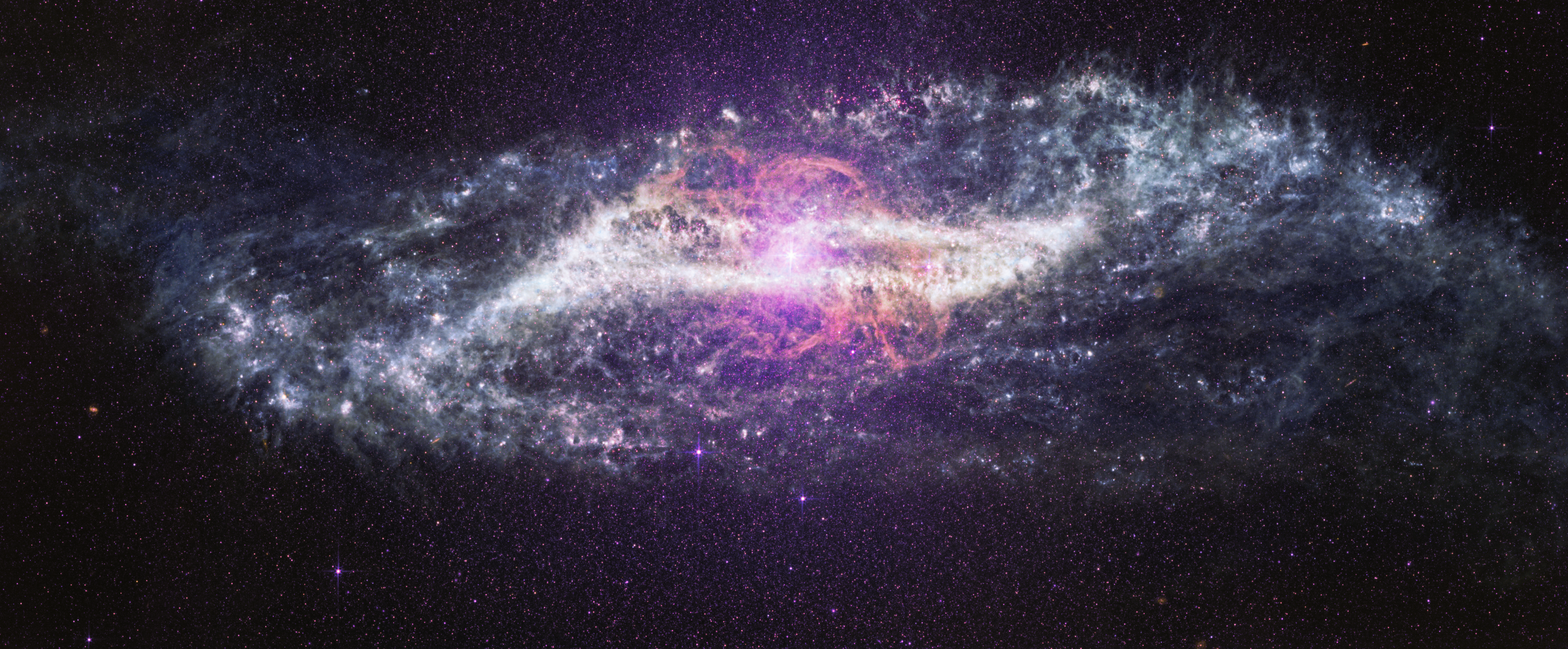
NASA's James Webb Space Telescope captured a detailed infrared portrait of Centaurus A, revealing the dusty structures and violent activity within this peculiar nearby galaxy. The image, taken by MIRI (Mid-Infrared Instrument) on July 6, 2026, exposes previously hidden regions obscured by dust at visible wavelengths.
Centaurus A sits 11 million light-years from Earth, placing it among our cosmic neighbors. Despite its relative proximity, this galaxy defies expectations. Unlike most galaxies at similar distances, Centaurus A hosts intense activity. The infrared observations pierce through the dust cocoons surrounding active regions, allowing astronomers to map the energetic processes within.
MIRI's infrared sensitivity reveals structures invisible to optical telescopes. The instrument detects heat signatures from dust warmed by energetic phenomena, including jets and accretion around the central supermassive black hole. These features shape the galaxy's unusual morphology and dynamics.
Centaurus A's starburst activity produces massive numbers of new stars within compressed regions. The dust structures captured in this image trace the pathways of gravitational forces and radiation from these stellar nurseries and the black hole itself. The infrared data helps astronomers understand how galactic collisions trigger such intense episodes of star formation and how supermassive black holes influence their host galaxies.
Webb's infrared capabilities prove essential for studying dusty galaxies across cosmic distances. By observing Centaurus A's detailed structure through dust, scientists refine their understanding of galaxy evolution and the interplay between black holes and star formation. These observations provide a template for interpreting similar processes in distant, early-universe galaxies that appear increasingly dusty and energetic.
The July 2026 observation contributes to Webb's ongoing survey of nearby active galaxies, building a comprehensive catalog of how black holes and stellar activity