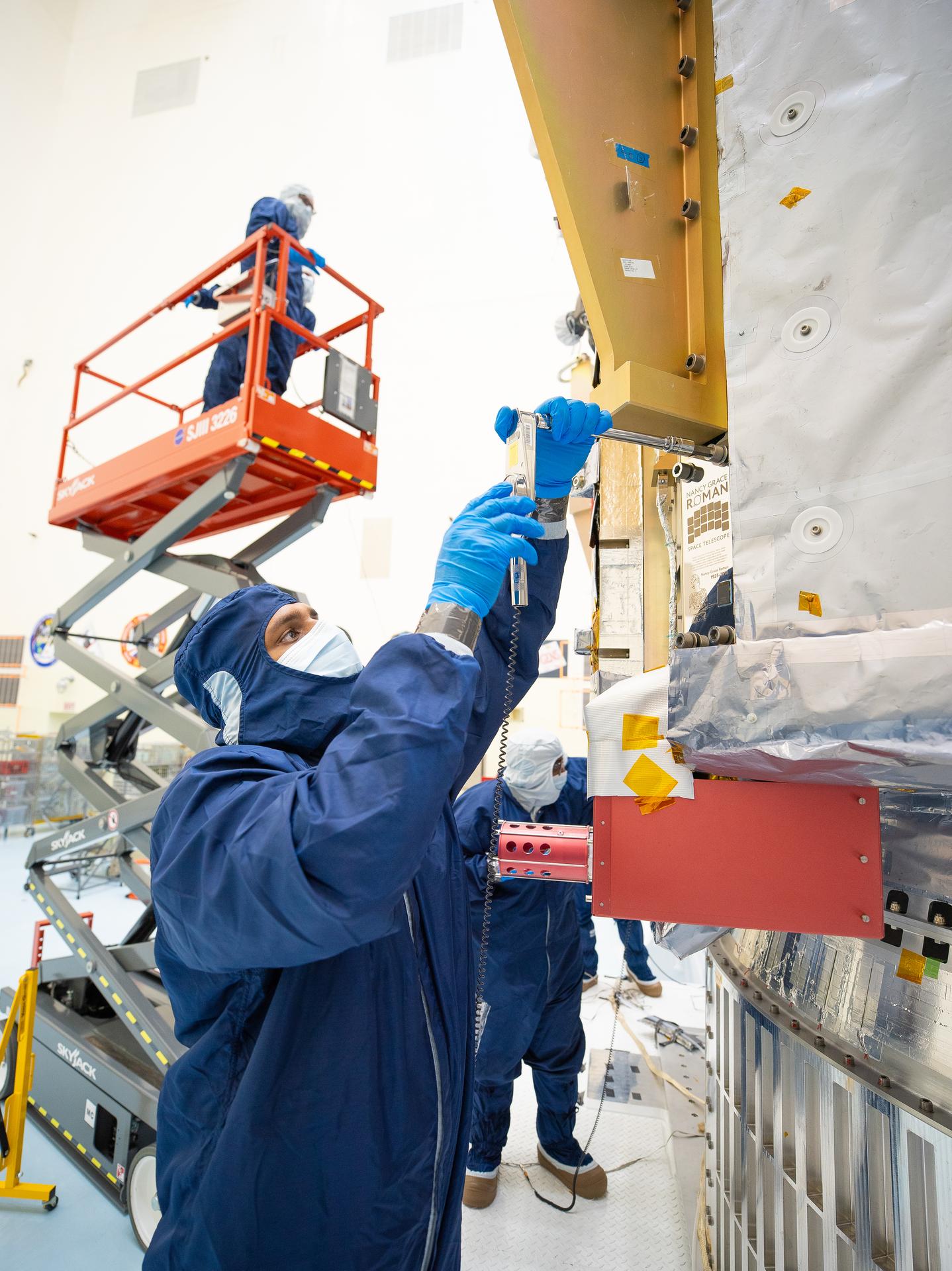
NASA has installed a memory card carrying 1.35 million names aboard the Nancy Grace Roman Space Telescope at Kennedy Space Center in Florida. Technicians completed the installation on July 27 as part of a commemorative plaque that will accompany the observatory into space.
The names submitted by people worldwide include astronauts designated for Artemis II and Artemis III, NASA's lunar exploration missions. The memory card transforms a public participation program into a physical artifact that will journey beyond Earth orbit aboard one of NASA's most ambitious astrophysics missions.
Roman, named after NASA astrophysicist Nancy Grace Roman, represents a major advance in space-based observation technology. The telescope will conduct surveys of exoplanet populations, study dark energy and dark matter, and observe distant galaxies with infrared capabilities. Its wide field of view allows Roman to image areas of sky roughly 100 times larger than Hubble Space Telescope observations.
The plaque itself serves as a bridge between Earth-based communities and deep space exploration. By carrying submitted names aboard Roman, NASA extends human participation in space exploration beyond the handful of astronauts and scientists directly involved in missions. The global collection reflects contemporary interest in space science and astronomy.
Roman's launch remains scheduled for the mid-2020s. Once deployed, the telescope will operate at the Sun-Earth L2 Lagrange point, approximately one million miles from Earth. From this vantage, Roman will conduct its mission independent of Earth's atmospheric distortion and thermal interference.
The inclusion of public names on space missions connects civilian supporters to scientific endeavors conducted for broader understanding of the cosmos. This commemorative approach echoes similar programs on other NASA missions, embedding human participation in the physical record of space exploration itself.