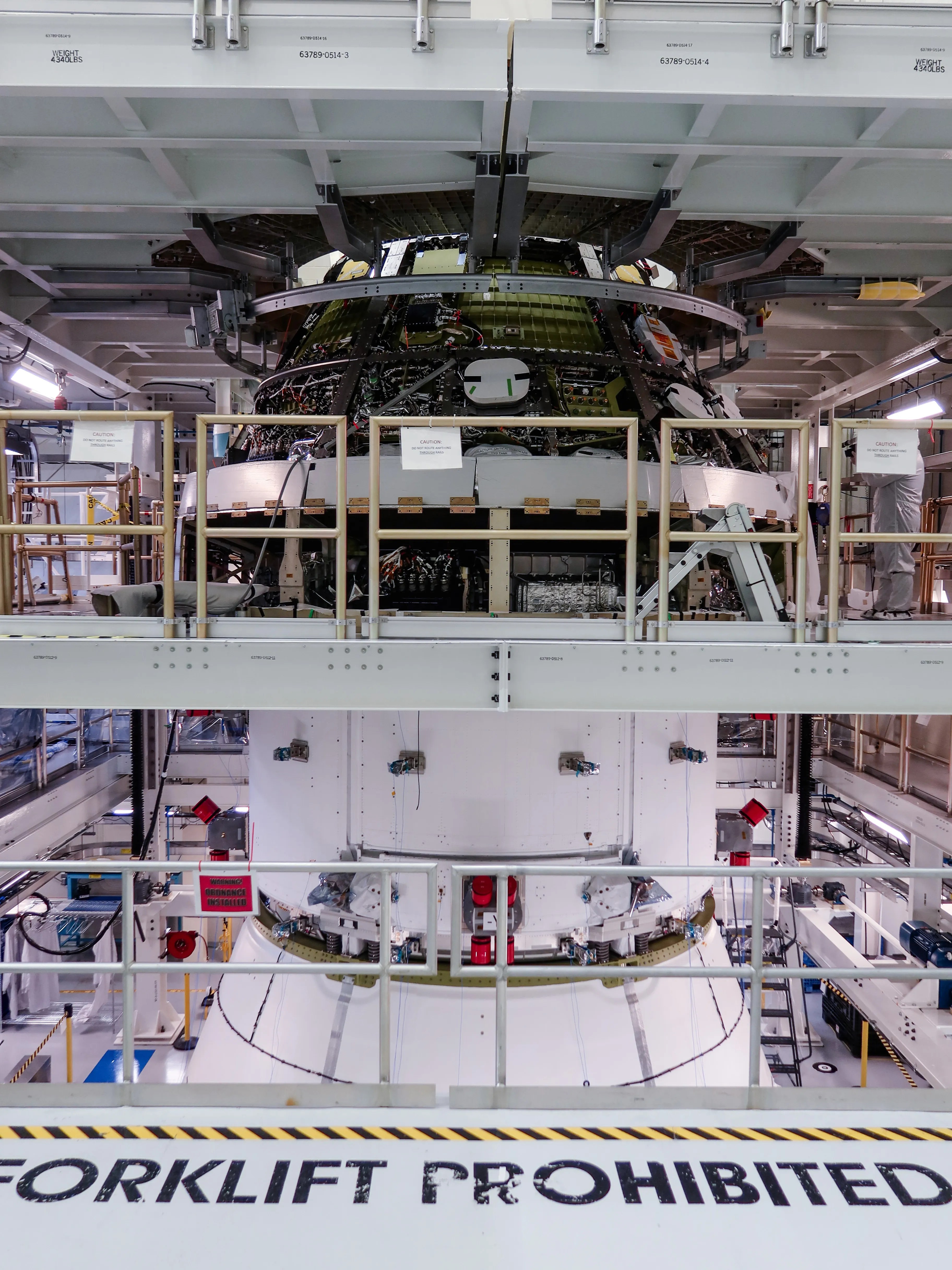
NASA technicians completed a major assembly milestone for Artemis III on July 30, 2026, joining the Orion crew and service modules at Kennedy Space Center in Florida. The integrated spacecraft will transport four astronauts to lunar orbit: NASA astronauts Randy Bresnik, Andre Douglas, and Frank Rubio, along with ESA astronaut Luca Parmitano.
The crew module houses life support systems, avionics, and crew accommodations for the trans-lunar journey. The service module provides propulsion, power, thermal control, and consumables for the mission. Mating these two critical components represents a pivotal step toward the Artemis III flight, which aims to land humans on the lunar surface for the first time since Apollo 17 in 1972.
The assembly occurred inside the Neil Armstrong Operations and Checkout Building, NASA's premier facility for spacecraft processing at Kennedy Space Center. This location has hosted assembly and testing of human spaceflight vehicles for decades, from Space Shuttle components to Orion hardware for previous Artemis missions.
Artemis III builds on the foundation of Artemis I, an uncrewed test flight in 2022, and Artemis II, a crewed lunar flyby planned for 2025. The three-mission architecture validates the Orion spacecraft and Space Launch System rocket before committing humans to surface operations in the lunar south polar region, where permanently shadowed craters contain water ice.
The crew module and service module integration represents months of preparation by NASA teams and contractors. Each component underwent rigorous testing before joining. Once combined, the integrated stack will continue processing, including thermal vacuum testing and final validation before shipment to the launch pad.
This assembly event underscores NASA's commitment to returning humans to the Moon with international partnership. The inclusion of Parmitano reflects the collaborative nature of modern space