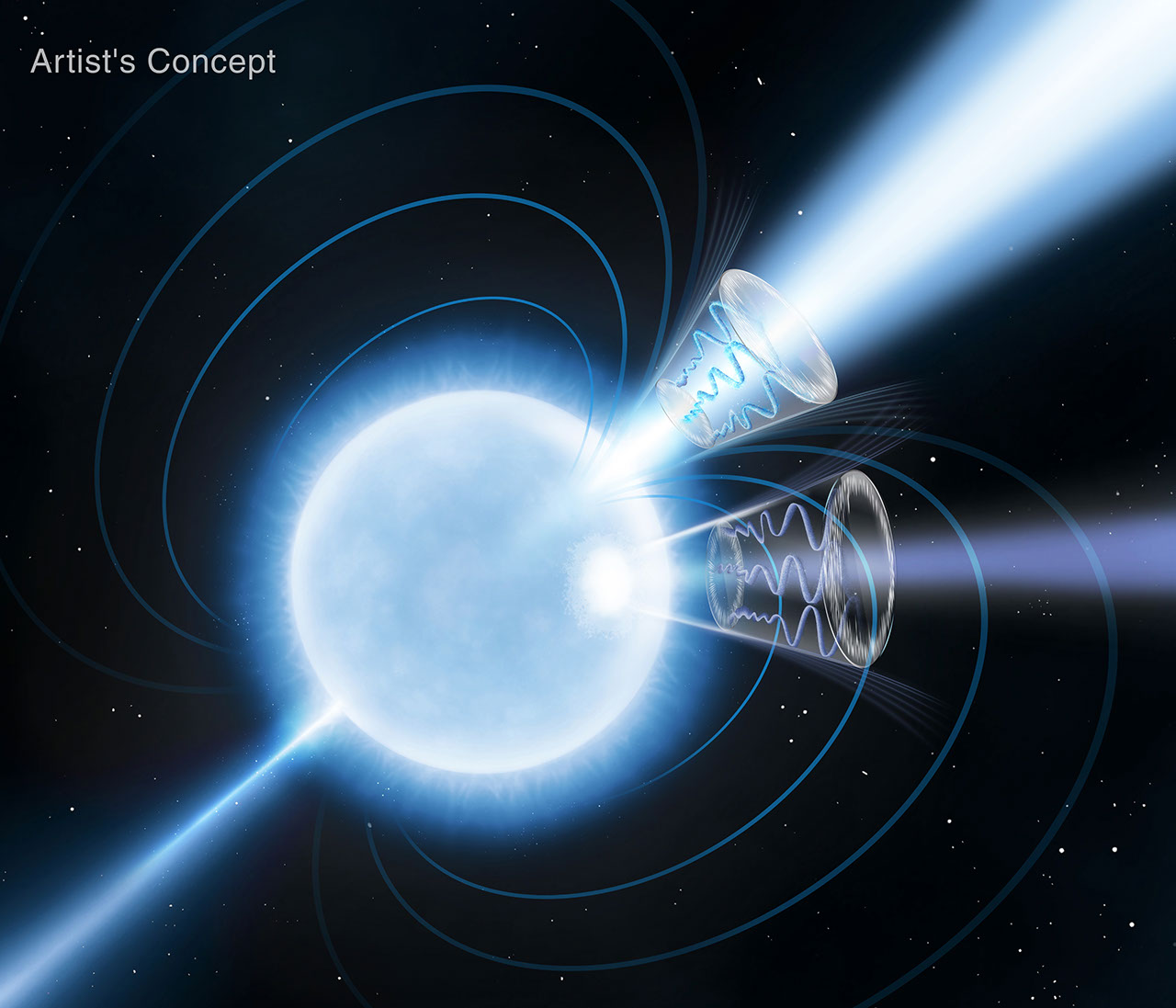
NASA's Imaging X-ray Polarimetry Explorer detected the first direct evidence of quantum electrodynamics in action around a magnetar, validating theoretical physics predictions from the 1930s. The mission conducted over 140 hours of observations of magnetar 1E, publishing the findings in Nature.
The discovery centers on an extreme phenomenon called birefringence. In the intense magnetic fields surrounding a magnetar, the vacuum of space itself behaves like a prism, bending light differently depending on its polarization. This effect stems from quantum electrodynamics, the framework that describes interactions between light and matter at the subatomic level. Physicists calculated this behavior should occur in 1936, but detecting it required instruments sensitive enough to measure X-ray polarization in regions billions of times more magnetic than Earth's field.
IXPE made this breakthrough possible. Launched in December 2021, the mission represents the first space observatory dedicated to measuring X-ray polarization. By analyzing how X-rays scatter off magnetar magnetic fields, IXPE researchers obtained direct proof that the vacuum exhibits birefringence exactly as quantum electrodynamics predicts.
Magnetars rank among the universe's most extreme objects. These neutron stars spin rapidly and possess magnetic fields so powerful they would prove lethal from 600 miles away. Only about 30 magnetars are known in the Milky Way. Their extreme conditions create natural laboratories where physics operates under circumstances impossible to replicate on Earth.
This detection opens new avenues for testing fundamental physics. By observing magnetars and other high-field environments, astronomers can refine their understanding of quantum electrodynamics in regimes where standard laboratory experiments cannot reach. The result demonstrates how space-based X-ray observatories unlock secrets about the universe's fundamental nature.
IXPE continues observations designed to explore how