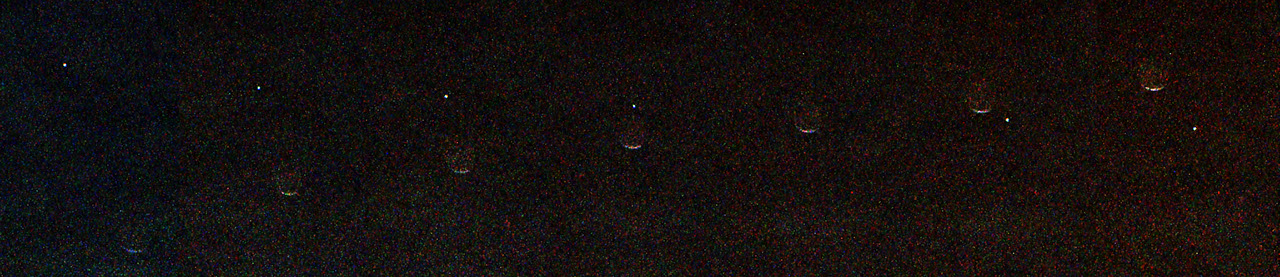
NASA's Perseverance rover captured a rare alignment on July 2, 2026, when Earth and Phobos crossed paths in the Martian sky. The Mastcam-Z instrument aboard Perseverance documented the event across seven composite images, showing Earth as a bright dot passing behind Mars' larger moon during the rover's 1,907th sol of operation.
This observation represents more than a striking photograph. It provides Perseverance with direct optical data about Phobos' orbital mechanics and position relative to Mars. Such measurements help refine our understanding of the small moon's trajectory and gravitational interactions with the Red Planet. Phobos, only 22 kilometers across, orbits Mars roughly every 7.6 hours, making it the innermost large moon in the solar system.
The alignment also demonstrates the rover's sophisticated imaging capabilities. Mastcam-Z, the zoomable camera system on Perseverance, can track fast-moving objects and capture fine detail across varying distances. The black background in the composite indicates the camera's ability to isolate celestial objects against the Martian atmosphere and sky.
For scientists on Earth, witnessing their home planet from Mars carries practical value beyond sentiment. Tracking Earth's position and brightness from the Martian perspective aids spacecraft navigation and refines our models of how celestial bodies appear across the inner solar system. This data feeds directly into planning for future Mars missions and understanding how to guide spacecraft between worlds.
Perseverance, which landed in Jezero Crater in February 2021, continues executing its primary mission of searching for signs of ancient microbial life while characterizing the Martian environment. The rover's instruments, including Mastcam-Z, contribute layered datasets about Mars' geology, atmospheric conditions, and orbital dynamics. Observations like this eclipse event become part of the broader