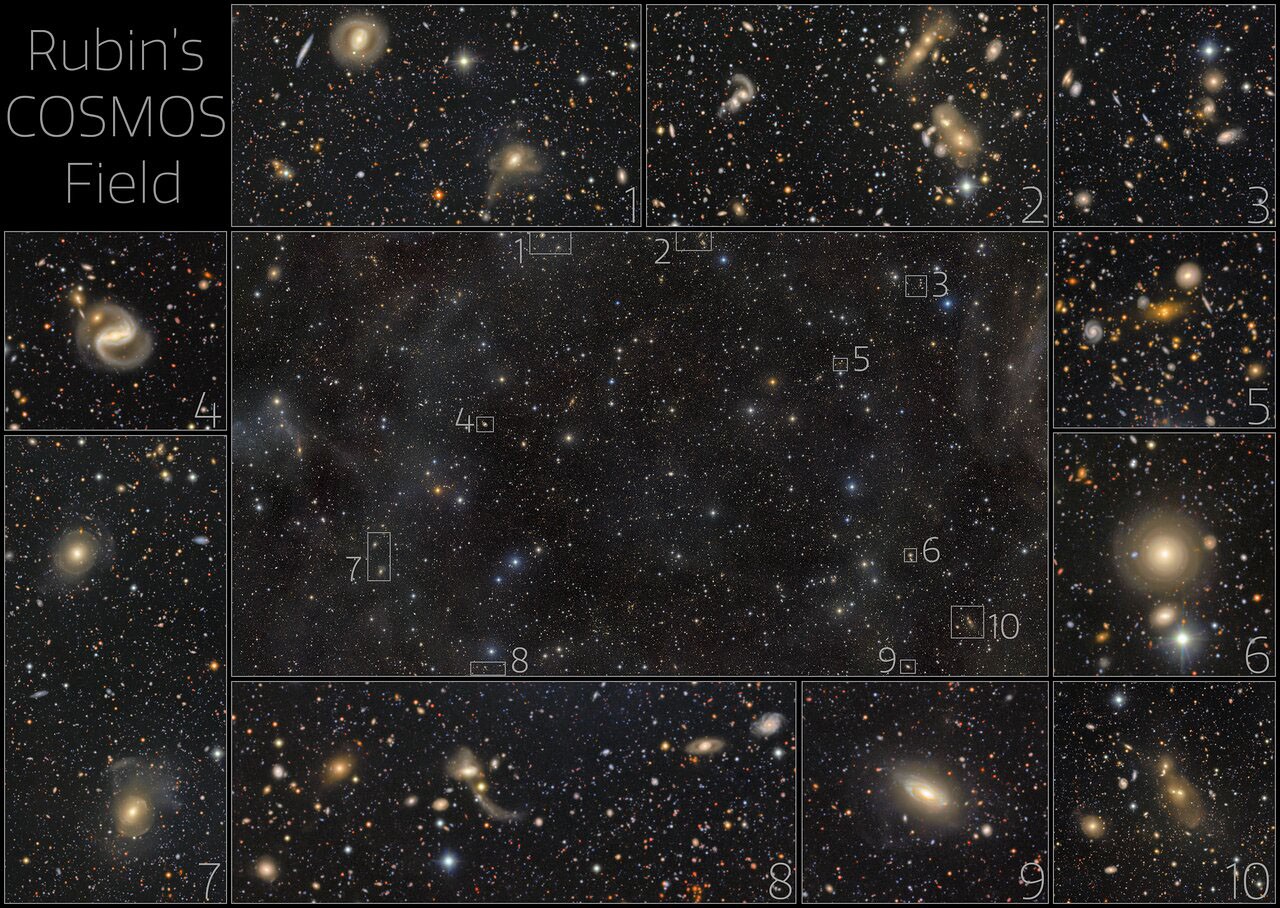
The Vera C. Rubin Observatory's COSMOS field survey captures an unprecedented view of the deep universe, revealing thousands of galaxies across billions of light-years. This astronomical dataset, named for pioneering astronomer Vera Rubin, represents one of the most comprehensive wide-field observations ever conducted from Earth.
The COSMOS field survey spans approximately 1.5 square degrees of sky and catalogs galaxies at vast distances and across multiple wavelengths. Rubin Observatory's Legacy Survey of Space and Time (LSST) instrument delivers imaging with resolution and sensitivity that enables astronomers to map cosmic structure on scales never before achieved. The survey documents galaxy distributions, measures redshifts to determine distances, and traces dark matter's gravitational influence across cosmic time.
This data directly advances several research frontiers. Cosmologists use COSMOS observations to constrain dark energy models and test the expansion history of the universe. The catalog enables galaxy evolution studies, showing how galaxies assemble, merge, and transform from the early universe to present day. Researchers also identify rare objects. extreme quasars, and transient phenomena that would escape detection in smaller surveys.
The naming honors Vera Rubin's legacy in observational astronomy. Her work on galaxy rotation curves provided the first direct evidence for dark matter's existence, fundamentally reshaping our understanding of the cosmos. The COSMOS field extends that investigative spirit into the modern era, applying today's most powerful instrumentation to questions Rubin helped formulate.
Rubin Observatory operates as a public facility, ensuring the COSMOS dataset remains accessible to the international astronomical community. This openness accelerates discovery. Amateur astronomers, universities, and major research institutions all draw from the same deep imaging archive. The survey's scale and depth position it as a reference dataset for comparative studies across decades of future research.
The COSMOS field observations provide the foundational data